
1428
King Henry VI 1428
1428
Henry VI
ANNO VI-VII

King Henry VI (1422-1461) was the third and last Lancastrian king of England.King Henry’s regnal year dates from 1 September to 31 August.
Four of the primary sources covering King Henry’s reign, the Proceedings of the Privy Council, the Foedera, selected texts from the fifteenth century chronicles, and Letters and Papers Illustrative of the Wars of the English in France, arranged chronologically by year, are brought together in the text with references to other authorities, primary and secondary. A bibliography is appended at the end of each year.
See Introduction.
See list of Years above:
The Minority Years 1422-1437.
King Henry’s Personal Rule 1437-
******************************
֍Key Events
Cardinal Beaufort returned to England to prepare for a crusade.
The Earl of Warwick became King Henry’s guardian.
The siege of the city of Orleans.
The death of Thomas Monatgu, Earl of Salisbury
*******************************
Contents
The Minority Council
The Proceedings record twenty-six meeting in 1428.
Council Attendance
Seventeen councillors attended.
Parliament
 Parliament convened on 13 October 1427 and was prorogued on 8 December to meet again on 27 January 1428. It was dissolved on 25 March 1428.
Taxation
 A wine tax, tunnage and poundage.
A new tax parish tax.
Knights’ fees.
Council Proceedings
The Duke of Gloucester.
Gloucester Castle.
John, Bastard of Clarence.
Sir John Fastolf.
French Prisoners.
Customs duties: records to be submitted annually to the Exchequer.
Royal Justice
John Roger.
Commissioners of the Peace
John Mowbray, Duke of Norfolk
Justices of Assize
 Sir William Babington,
Thomas Fulthorpe.
John Fray.
The Duke of Gloucester and Parliament
 Gloucester demanded a recognition of his powers as Protector.
Richard Beauchamp, Earl of Warwick
 The Earl of Warwick was appointed King Henry’s governor.
King Henry VI’s Household
The Duke of York joined the royal household.
Knights and esquires of the body were assigned to the household.
Master John Somerset.
Thomas Chaucer.
John Merston.
Schedule of Expenses
John Gedney.
King Henry VI’s Court
Henry’s generosity.
Court expenses.
Pedro Prince of Portugal.
The Church
 Henry Chichele and Pope Martin.
The Abbot of Abingdon
James Chartanes, papal envoy, was allowed to depart free of customs duties.
Pilgrimages
Licences were issued for ships to convey pilgrims to the shrine of St James de Compostela.
London
 Weather and Food.
Baynard’s Castle.
London Bridge.
A clock at Westminster.
The Duchy of Gascony
 Gaston de Foix.
Pons VIII Lord of Castillon.
Sir Amaniu Béguey.
Guilhotin Andron, Lord of Lansac.
Sir John Radcliffe.
Scotland
 King James’s ransom.
Cardinal Beaufort’s Return to England
 Preparations for a crusade.
Heretics.
John Wycliffe.
Indulgences.
Cardinal Beaufort and King James of Scotland
A proposed meeting between the Cardinal and the King.
Envoys to Rome
An embassy to the Emperor and the Pope.
Talks in Rome with representatives of King Alfonso of Aragon.
The King of Portugal
 King Joâo I alliance and friendship with England.
The Hanseatic League
Hanse privileges.
English merchants’ petition in Parliament.
The Netherlands
A Doubtful Procuration
Flanders.
Letters of marque.
Holland and Zeeland.
A Doubtful Procuration.
Jacqueline of Hainault
 Jacqueline and the Duke of Gloucester.
Jacqueline and the Duke of Burgundy.
The Duke of Brittany
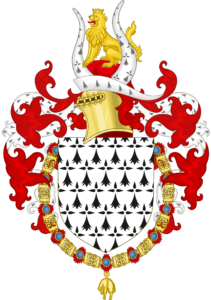 A Treaty with Brittany.
A misdated embassy?
The War in France

The Regent Bedford’s Administration
 The Estates of Normandy.
Income and expenditure: William Worcester’s Collections.
Argentan.
The Earl of Salisbury’s army
 Salisbury’s indenture.
Salisbury’s campaign strategy.
The Duke of Bedford and an abstinence de guerre
Proposal for a truce.
The Siege of Orleans
 The siege of the city of Orleans.
The Death of the Earl of Salisbury
 Salisbury was killed at Orleans less than a month after he laid siege to it.
Thomas Montagu, Earl of Salisbury, an Obituary
Bibliography 1428
A list of primary and secondary sources referred to in the text.
************************************
A Note on Money
There were two types of money in the fifteenth century, money of account and actual coinage.
Money of Account
The English pound [£] or livre was divided into 20s (shillings) the shilling into 12d (pence).
The English mark was worth 13s 4d – two thirds of a pound
In France the livres tournois was the standard money of account. Divided into 20 sous and 12 deniers. Nine livres tournois equalled one English pound.
Coinage
There were no pound, mark, or shilling coins.
The English noble was a gold coin worth 6s 8d, half a mark.
The English silver penny was also a money of account and worth 1/240th of one pound sterling.
Silver minted coins: Groat = 4 pence; half groat; penny; halfpenny; farthing
In France the franc was a silver coin worth one livre.
The ecu was a gold coin worth 3s 4d sterling.
The salut was a gold coin minted in in Lancastrian France worth one and one half livres or 30 shillings. The French also minted the salut.
Incomes
A rough estimate of incomes: a parish priest received between £5 and £10 a year depending on the wealth of his parish., An archer might expect to earn £9 a year. The average income of a knight was £60. A lord’s income from land and crown annuities amounted on average to £865 from which he would pay his retinue and domestic servants. Richard, Duke of York the richest magnate in England claimed to be worth £3,230 a year.
Taken from J. Sumption, The Hundred Years War vol V, Triumph and Illusion, pp. 822-823.
The Minority Council
 The Proceedings record twenty-six meetings in 1428. Seven in February and two in March while Parliament was in session. One in April, three in May, one in June, eight in July, one in October and three in November.
A council meeting on 15 June is not recorded in the Proceedings, but it was important. On 25 March the day it was dissolved, Parliament authorised the Council to deal with the all the petitions from the Commons that had not been answered during the parliamentary session. These were attended to by the Council in the Star Chamber with the chief justices, the chief Baron of the Exchequer and John Fray, third Baron of the Exchequer, present (1).
(1) PROME X, p. 364 (Council to deal with petitions).
Council Attendance
Councillors attending in 1428: No names are listed for the meetings in April, May, October and November.
Duke of Gloucester. February, March, June, July
Archbishop Chichele. February, March, June, July
Archbishop Kemp, Chancellor. February, March, June
Duke of Norfolk. May, June
William Grey, Bishop of London. February, March, June, July
John Stafford, Bishop of Bath. February, March, June, July
Philip Morgan, Bishop of Ely. February, March, June, July
Thomas Langley, Bishop of Durham, June, July
John, Earl of Huntingdon. February, March, June, July
Humphrey, Earl of Stafford. February, March
Thomas Montague, Earl of Salisbury. February, March, June.
Lord Cromwell. February, March, June, July
Lord Tiptoft. February, March, July
Lord Scrope. February, March, June, July
Louis Robessart, Lord Bourchier. February, July
Lord Hungerford, Treasurer. February, March, June, July
William Alnwick, Keeper of the Privy Seal. February, March, June, July
Parliament
Parliament met for its second session on 27 January 1428. It was dissolved on 25 March 1428. Most of the important business of this Parliament was conducted in 1428.
“And in the year 1427 the king held parliament at London after the Feast of All Saints; it was prorogued until after Christmas.” Benet’s Chronicle, p. 181
“And that yere there was a Parlyment at Westemyster, and that beganne a Synt Edwardys day in Lent.” Gregory’s Chronicle p. 162
Gregory’s Chronicle has the correct date for convening parliament, 13 October, St Edward the Confessor’s Day, but adds ‘in Lent.’ This is a reference to the second session: 18 March (in Lent) was St Edward, king and martyr’s day.
Taxation
On 25 March 1428, the Speaker announced that the Commons had voted a tax of 3 shillings on every tun of wine imported by English merchants for one year from 4 April 1428.
Tunnage and poundage was renewed for the same period, but not back dated, although the previous grant had expired in November 1427. Any English merchant who evaded these taxes faced a penalty of double what they should have paid.
The Commons also granted a new tax in two-parts:
A Parish tax
A levy on parishes based on the value and location (urban or rural) of the[ir churchand the size of the parish. Every rural parish with ten or more householders whose church was valued at less than ten marks would pay 6s. 8d.
Parishes with churches valued at more than 10 marks would pay a minimum of one mark [13s 4d]. Urban parishes whose churches were valued at 20 shillings (£1) or more would pay a minimum of two shillings, on an upward sliding scale.
The Commons expected Convocation to match their generosity by imposing the standard tax of a tenth on the clergy.
Knights’ fees
A second levy was on crown lands held as knights’ fees. Knights’ fees could be imposed on one man’s estate or on estates divided among a number of men (or women); anyone holding a quarter or more of land subject to a knight’s fee was liable for a minimum of 6s 8d, on a rising scale. This tax would not be popular, and the Commons protected their own: no member of parliament was to be named as a tax commissioner (1).
The parish tax would be collected by the following May, and the knights’ fees by the end of June.
(1) PROME X, pp. 330-331.
 Chronicles
Only Chronicles of London (Julius B I, p. 288) has a complete record of the taxes, including the requirement imposed by the Commons that aid should be sent to Jacqueline of Hainault.
See Jacqueline of Hainault below.
Brut Continuation E (misdated to Anno 1423-1424) and Brut E Appendix have a muddled, misdated, and fragmentary account of the parish tax, noting the sliding scale of the tax but substituting £20 for 20 shillings and £2 for 2 shillings.
“[ ] at xx li. þe parysshesens shuld pay xl s; And yf it were of more valewe, þen pay more.” Brut Continuation E p. 449.
“And after that was graunted bi the parliament, þat all the chirches of the ralme shulde be stent at a somme; and the Chirche were at xx li, the paresshens shulde paye xls; and iff it were of more valewe, than to paye more. Brut E Appendix, pp. 453–454
The Great Chronicle (p. 151) documents the parish tax, but not the knights’ fee, but both chronicles match the parliamentary rolls word for word.
“And the laity granted the king a tax of a tenth on their parishes, and the merchants granted the tax called ‘tunnage and poundage.’ Benet’s Chronicle p. 181
Council Proceedings
The Duke of Gloucester
Gloucester Castle
Sir John Pauncefot was allocated £200 for repairs to Gloucester Castle, the work to be supervised by the Prior of the Augustinian Priory of Llanthony Secunda near Gloucester (1). The Duke of Gloucester was constable of Gloucester castle.
(1) PPC III, p. 318 (repair to Gloucester Castle).
The Mortimer Estates
Edmund Mortimer, Earl of March died childless in Ireland in 1425. His heir was Richard, Duke of York, who was still a minor. Custody of the Mortimer estates, with certain exceptions, was granted to the Duke of Gloucester.
See Year 1425: The Mortimer Inheritance.
Gloucester surrendered his letters patent in November 1428 and received an amended grant, specifying the exceptions. He was to pay £1,764 4s 6d annually to the crown out of the proceeds of the grant but was allowed £361 17s 8d for the wages of the estates’ officers. He would retain custody of them for the next three years, until the seventeen-year-old Duke of York came of age (3).
See King Henry’s Household, the Duke of York below
Thomas Beaufort, Duke of Exeter died at the end of 1426. His executors drew £339 from the estates of Edmund Mortimer Earl of March who died in 1425 to help pay Exeter’s debts. The honour of Wyrmegey [Wormegay co. Norfolk] was also committed to his executors (1).
The Council agreed that no further assignment should be made on the Mortimer estates until the executors had recovered the £600 they spent on the jewels sent to Pope Martin in accordance with a bequest in Exeter’s will (2).
**************************************
(1) Harriss, Beaufort, pp. 162-163 (Exeter’s lands).
(2) PPC III, p. 311 (jewels to the pope).
(3) PPC III, p 313 (grant to Gloucester).
****************************************
John, Bastard of Clarence
John, Bastard of Clarence was a king’s knight, but as the illegitimate son of Thomas Duke of Clarence, he had no inheritance from his father’s estate; he depended on grants from the crown for his livelihood.
In July 1428 the Council granted him £100 from the manors of Esker, Newcastle-on-Lyons, Cromelyn and Tassagard in Ireland (valued at £140 a year). They had been held by Janico Dartas, Constable of Dublin castle, under Henry IV and Henry V. Dartas was dead by November 1427.
See 1426: Ireland
The manors were granted as a reward for helping Thomas Monatgu Earl of Salisbury recover the Duke of Clarence’s body. Clarence was killed at the Battle of Baugé in 1421. John brought the body back to England for burial in Canterbury Cathedral (4).
(1) Foedera X, p. 406 (grant to Bastard of Clarence).
Sir John Fastolf
Fastolf was Grand Master of the Duke of [Regent] Bedford’s household in France, and so was rarely in England. He was granted a letter of protection for one year in October 1428 for his manor of Caister near Great Yarmouth (1).
(1) Foedera X, p. 408 (Fastolf).
French prisoners
A safe conduct for Raoul de Gaucourt to return to England dated June 1428 in the Foedera cannot belong in 1428 (1). By that time Gaucourt was in command of the garrison defending the city of Orleans against the Earl of Salisbury (2).
See The Siege of Orleans below.
It may not belong in Henry VI’s reign at all. Gaucourt had been a prisoner in England since he and Jean d’Estouteville surrendered Harfleur to King Henry V in 1415. In June 1416 Gaucourt received a safe conduct from King Henry to go to France as part of a peace initiative promoted by the Emperor Sigismund (3).
The safe conduct may belong in 1424 when Gaucourt received permission to go to France to raise his and Jean d’Estoutreville’s ransoms and return by 1425. Estouteville and Gaucourt probably left England in late 1425 after their ransoms had been guaranteed by Parliament to Sir John Cornwall to obtain the release of the Earl of Huntingdon.
See Year 1424: John Holand, Earl of Huntingdon.
Estouteville and Gaucourt’s servants continued to receive safe conducts to come to England bringing instalments of the ransom:
Three servants in January 1426 bringing gold, silver, and other goods (4).
Helliot de Linaye and Colin Fleming, in May 1427 coming to Sir John Cornwall (4).
Three safe conducts were issued at the end of 1428 to servants of Raoul de Gaucourt, Jean d’Estouteville, and Charles d’Artois, Count of Eu who was still a prisoner in England (6). This may have been the final instalment of Estouteville and Gaucourt’s ransom.
***************************************************************
(1) Foedera X, pp. 402-403 (Gaucourt’s safe conduct dated to 1428).
(2) Sumption V, Triumph and Illusion, p. 236 (Gaucourt at Orleans in 1428).
(3) Sumption, IV, Cursed Kings, p. 484 (Gaucourt in 1416).
(4) Foedera X p 350 (safe conducts 1426).
(5) Foedera X, p. 374 (safe conducts 1427).
(6) Foedera X, p. 396 (three safe conducts 1428).
************************************************
Customs Duties
The Council issued an ordinance to the Treasurer and Barons of the Exchequer in November 1428, to be confirmed by writ of the Chancellor, that a record in book form must be compiled and kept annually at the Exchequer of the names of all merchants entering or leaving the country, the quantity and value of the goods and merchandise imported or exported in all the ports in England.
Exports must be recorded before the goods were shipped, and imports before the merchandise was unloaded. Once the information had been entered in the book, no customs officer or anyone else could erase or alter the entry on pain of imprisonment or fine.
All shipping activities must be undertaken in daylight hours (no smuggling at night!). The searchers were to be supplied with a copy of the customs declarations of the value of the goods, and of the names of the merchants shipping them. Every ship must be searched before being unloaded or allowed to leave port (1).
One wonders why this was suddenly necessary. Customs accounts had been kept since the thirteenth century, and the mechanism was well established. The major ports had a regular customs staff, collectors, controllers, searchers, trongers (weighers of goods) and clerks (2, 3). Did the Council suspect that the crown was being defrauded, or were they so desperate for money that they felt the need to tighten the regulations even further?
************************************
(1) PPC III, p. 315 (customs book).
(2) Brown, Governance of Late Medieval England, pp. 69-70 (customs staff).
(3) Postan, Medieval Trade and Finance, ‘English studies of the customs accounts,’ pp. 353-360.
************************************
Royal Justice
The king’s justice was supposed to be impartial, but the obligations of a lord to protect his tenants, clients, and retainers resulted in frequent and often irreconcilable conflicts of interest. Magnates were prone to put their local interests above those of royal justice in judicial decisions and the Council made periodic efforts, usually ineffectually, to curb partisan injustice.
Even the judges doubted the efficacy of royal justice at times. Judges were summoned to the Star Chamber to pronounce on the question of whether the Council should fine John Roger who was accused of evading customs duties by shipping wool from the port of Melcome ‘which port was not included in the statute’ there and then or whether the case should be referred to a jury. Their reply was that since the jurors would in all probability be bribed and corrupted, their advice was to impose a fine immediately. John Roger was duly fined 200 marks (1).
(1) PPC III, p. 313 (John Roger fined).
Commissioners of the Peace
Commissioners of the peace were appointed for every shire in England to assist the sheriffs in maintaining law and order. In July 1428 the Council agreed that magnates named to commissions of the peace should not sit on routine local court proceedings in counties where they held estates, except in serious cases such as riots and invasions of property which required oyer and terminer commissions.
John Mowbray, Duke of Norfolk protested at the Council’s decision. He preferred to have his name removed from the commissions of the peace rather than surrender his right to conduct local justice as he saw fit.
Norfolk and the Earl of Huntington had been named as commissioners of the peace in Bedfordshire in 1426. In 1428 the council ordered them not to sit on the assizes in Bedfordshire, effectively immediately. Similar writs were issued to all the justices of that county, and no other magnates were named as commissioners of the peace for Bedfordshire (1).
(1) PPC III, p. 302.
Justices of Assize
Sir William Babington, a chief justice of the Court of Common Pleas, and Thomas Fulthorp, were appointed justices of assize (itinerant judges) in the counties of York, Northumberland, Cumberland and Westmorland, the city York, and the town of Newcastle-on-Tyne, replacing John Preston and Robert Tirwhit, who had died.
John Fray, third Baron of the Exchequer became Babington’s deputy in Norfolk (1, 2).
*******************************************
(1) PPC III, p. 283 (Babington, Fulthorp and Fray).
(2) CPR 1422-1429, p. 459 (Babington and Fulthorp).
***************************************
The Duke of Gloucester and Parliament
The Duke of Gloucester expected to become Regent of England after King Henry V’s death, but the lords had refused to recognise his claim. The Parliament of 1422 made Gloucester Protector of England only while the Duke of Bedford remained in France.
See Year 1422: The Minority Council.
Gloucester had not enjoyed playing second fiddle to this brother during the Duke of Bedford’s stay in England in 1426/1427. or of being forced to concede, temporarily as he saw it, supreme authority to the Minority Council.
See Year 1426: The Duke of Bedford and the Duke of Gloucester.
See Year 1427: The Duke of Bedford and the Council.
Towards the end of the first session of Parliament in December 1427, Gloucester appealed for clarification of his powers as Protector, claiming a diversity of opinion among the lords as to what the title entailed, and “wishing therefore for his power and authority in this regard to be made fully certain.” He offered to withdraw from the parliament chamber while the question was debated (1)
Gloucester raised the question of his status and authority as Protector again in the second session of Parliament in 1428, and this time he went further. He declared that although matters of policy might be debated in the absence of the Protector nothing could be passed except in his presence and he would not sit in parliament until he received a satisfactory answer.
The Lords’ Reply
Henry Chichele, the Archbishop of Canterbury, delivered the Lords’ reply on 3 March 1428. It was predictable to everyone except Gloucester: they rejected his argument outright. They reminded him that his claim to govern the realm as Regent by right of birth and kinship to the king had been rejected and that he had accepted the terms under which he had become Protector. These could not be altered. Parliament had bestowed the title of Protector on him to acknowledge his birth and to distinguish him from the other members of the Council, but he could not, as Protector, refuse to attend Parliament.
Chichele informed him that Lords were surprised he had raised the question. The Duke of Bedford had agreed to leave the government in the Council’s hands, and King Henry was growing up; it would not be too many more years before England would no longer require a Protector (1).
The two archbishops, nine bishops, four abbots, twelve magnates and lords, the Duke of Norfolk, the Thomas Montagu, Earl of Salisbury and the Earl of Huntingdon among them, signed the Lords’ declaration. Gloucester had no support in council at this time, and the claim of later historians, intent on establishing factions, that Salisbury and Huntingdon were in Gloucester’s camp, or of his faction, is unfounded (2).
***********************************************
(1) PROME X, pp. 347-349 (Gloucester’s role as Protector questioned and defined).
NB: There is no mention in the chronicles of Gloucester’s failed bid to achieve his ends.
(2) Watts, Henry VI and the Politics of Kingship, p. 117.
*********************************************
The Earl of Warwick: King Henry’s governor
 King Henry would be seven years old at the end of 1428, the first step on the road to manhood. He had been without a governor since the death of Thomas Beaufort Duke of Exeter at the end of in 1426. The choice to replace Exeter fell on the forty-six- year-old Richard Beauchamp, Earl of Warwick.
On 1 June 1428 the Council signed the warrant to be issued under the Great Seal in King Henry name appointing Warwick as the king’s governor (1, 2). The consent of the Duke of Bedford and the Duke of Gloucester was noted separately in a writ to the treasurer for Warwick’s salary, set at 250 marks annually (3).
Richard Beauchamp had been a close friend and companion of Henry V. He was considered the flower of chivalry: loyal, well educated, an excellent jouster, and an experienced war captain, although he had not, pace Shakespeare, fought at Agincourt. He was also a man of unquestioned orthodoxy; in his youth he had made a pilgrimage to the Holy Land. His son Henry Beauchamp, who became one of King Henry VI’s few close friends, was equally pious but less warlike.
“And anone aftir, as þe Erle of Warrewik ser Thomas (sic) Beauchampe, was sennd oute of Fraunce from þe Duke of Bedforde by all the worthy & discrete counsaill of Englande, he was made maister & gouernoure vn-to the Kynge during his non-age, & hym to goueren, teche & norish, as oweth to be done to such a worthy prince, to his lernyng of all maner worthynesse to good gouernance, discretion and reason.” Brut D Appendix, p. 442
“Ande that yere the Erle of Warwyke com home in to Inglonde owte of Fraunce, and he was made governer of the kynge.” Gregory’s Chronicle, p. 162
Warwick was to teach the king “good manners, literature, language, nurture (moral training) and courtesy,” to love and fear God, and to be virtuous in all things as became “so great a Prince.” Disciplining a royal child was a touchy subject; Warwick had the authority to ‘reasonably chastise’ the king should the need arise (4).
King Henry was to reside at Wallingford and Hereford (sic for Hertford), Queen Catherine’s residences, in the summer and the castles of Windsor and Berkhamsted in the winter unless there was plague or pestilence in the area, when Warwick could remove him to a safer place as he saw fit (5).
“And the king kept Christmas at Eltham, and Easter at Hertford. And the Earl of Warwick was made governor of the king.” Benet’s Chronicle, p. 181
******************************************
(1) PPC III, pp. 296-298 (Warwick king’s governor).
(2) Foedera X p 399 (Warwick king’s governor).
(3) PPC III, pp. 298-299 (Warwick’s salary).
(4) PPC III, pp. 299-300 (teaching and chastising the king).
(5) PPC III, p. 295 (royal residences).
*******************************************
King Henry Household
 The Council had established a household for King Henry in 1423. A budget of 10,000 marks [£6,666 13s 4d] for household expenses was allocated in 1424. In 1425 the Council ordered minors in the king’s ward to join the royal household as companions for the young king.
See Years 1423, 1424 and 1425: King Henry’s Household.
The Duke of York
In March 1428 a letter in King Henry’s name ordered the seventeen-year-old Richard, Duke of York to join the king’s household by no later than 25 April. York was the ward of Joan Beaufort Countess of Westmorland, and the Council informed her of their decision and requested her compliance (1).
See Year 1426: Joan Beaufort, Countess of Westmorland.
Knights of the Body
As Henry grew so did the numbers employed in his household.
In May four knights of the body, and four king’s esquires were ordered to join ‘the king’s master’ in the royal household: Sir William Phelip and Sir Ralph Rochefort had been Henry V’s knights of the body, Sir Walter Beauchamp and Sir William Porter were executors of Henry V’s will. ‘Each of them to have within his household one esquire and two valets (yeomen), provisions for their chambers, and a yearly fee of 100 marks and 50 marks respectively.
Esquires
John St Loo, John Chetwynd, Thomas Boulde, and William Fitzharry had all been esquires in Henry V’s household (2).
**********************************************
(1) PPC III pp. 292-293 (Duke of York to join royal household).
(2) PPC III, p. 294 (knights and squires to join household).
***********************************************
Master John Somerset
John Somerset was not related to the Beauforts, although Thomas Beaufort, Duke of Exeter was his patron and he witnessed Exeter’s will (1).
He had joined Henry’s household in 1427 as a physician and he remained in royal service of the next fifty years as physician and tutor to the king. He habitually pleaded poverty possibly because his fees were not always paid. I
n February 1428 he petitioned the Council for his annuity of £40 from the issues (crown income) of the City of London, and his clothing allowance of fur and linen as ‘other royal physicians have had yearly at the great wardrobe.’ They were granted to him on 27 February (2, 3).
****************************************************
(1) Wylie & Waugh, Henry V III, pp. 432–433 (brief biography of Somerset).
(2) PPC III, pp. 282-283 (petition in English); pp. 287-288 (petition repeated and grant in French).
(3) CPR 1422-1429, p. 460 (grant to Somerset).
**********************************************
Thomas Chaucer
Chaucer was chief butler of the household for life. He was responsible for ordering and accounting for the large quantities of wine supplied to the royal household. In February 1428 John Tiptoft, steward of the household, issued to writ under the privy seal to John Hotoft, treasurer of the household to make allowance to Chaucer in his accounts for the loss at sea (probably to piracy) of three shipments of wine between October 1426 and September 1427, one from France and two from Gascony:
One of three tuns from France to London via Le Mans and Rouen. One of just over four tuns coming from Gascony to London via Southampton and destined for the royal palaces of Woodstock and Wallingford. One of five tuns from Gascony destined for Windsor and Henley (1). A tun of wine equalled approximately 250 gallons (950 litres).
(1) PPC III, pp. 286-287 (wine lost at sea).
*****************************************************
John Merston
Merston did well out of the Council’s decision to confirm Henry V’s grants to his servants. He received a pension of 100 shillings as a king’s sergeant, and the £12 a year Henry V had granted him from the fee farm of the hundred of Dudeston, in Gloucestershire, payable by the Abbot of Gloucester. This was confirmed to Merston in May 1423 and again in July until he could be provided with a suitable office (1).
See Year 1423 King Henry V’s debts.
He became keeper of the king’s jewels in Henry VI’s household by 1427.
In February 1428 Merston petitioned the Council for an additional grant to cover the expenses of the king’s chamber during the New Year festivities which had exceeded the 200 marks allocated to him in February 1427 by £50 and 2 shillings, and that a further sum might be granted for expenses in 1428.
Also, that he might receive quittance for a gold ring set with a ruby which had been bestowed on King Henry by the Duke of Bedford. On the advice of Lord Tiptoft, steward of the household, and Alice Botiller, Henry had presented the ring to his mother Queen Catherine on Christmas Day (2).
***************************************************
(1) CPR 1422-1429, pp. 22, 93 and 110-111 (Henry V’s grants to Merston).
(2) PPC III, pp. 284-286 (Merton’s petition).
**************************************************
Schedule of expenses
On the dorso of the petition authorizing a warrant to pay Merston there is a reference per cedulam hiis annex. This is the schedule of expenses printed in the Foedera. Nicolas considered some of the items ‘curious’ but is it exactly what the keeper of the jewels would have produced to account for his disbursements within the still relatively small household of the king.
The first two items note the amounts paid to the servants of Queen Catherine and the Duke of Gloucester for bringing New Years’ gifts to the king. It was customary to reward such messengers on a sliding scale, the highest payment being for the queen’s servant, 66s. 8d, with 40 shillings for Gloucester’s servant and so on down.
The rest of the schedule is also for customary payments and rewards to members of Henry’s household, the ushers, yeomen, grooms and pages; to the heralds, minstrels and entertainers who were at court; the king’s alms and offerings, transport from Eltham to Hertford (where Henry spent Easter) for women servants and furnishings; livery collars for esquires attending Alice Botiller, the Earl of Warwick, the Earl of Ormond, and Lord Roos, and payments to craftsmen for refurbishing items in the great wardrobe (1).
(1) Foedera X, pp. 387-388 (expenses schedule).
John Gedney
John Gedney, the Mayor of London, petitioned the king for permission to take six fat deer from the royal parks: two from Eltham and four from Windsor (1). Gedney was a member of the Draper’s Guild, he supplied cloth to the Great Wardrobe on credit, which may be why his request was granted. Gifts of venison were highly prized. Lord Tiptoft as steward of the household dissented, he may have feared setting an expensive precedent.
(1) PPC III, p. 312 (Gedney venison).
King Henry Court
Henry VI’s propensity for indiscriminate and embarrassing gift giving manifested itself at an early age. The court was at Eltham for the Christmas/New Year festivities in 1427/1428.
“And the king kept Christmas at Eltham and Easter at Hertford.” Benet’s Chronicle, p. 181
During the festivities Henry snatched a gold collar from around the neck of the Earl of Oxford and bestowed it on James de Balalanex a visiting Polish knight. The council had to ‘purchase’ it from the earl for twenty marks (1, 2). Was Balalanex an envoy from Jagello V, King of Poland, or a knight errant, wandering the courts of Europe in search of employment or reward?
Henry was at Windsor in April for the celebration of St George’s Day and the Feast of the Garter in 1428. The Council paid 10 marks to a troupe of French actors and dancers who had been summoned to entertain the king and the court (3). A reward of 200 crowns was distributed to the kings of arms and heralds who had attended the ceremony at Leicester in 1426 when King Henry was knighted by the Duke of Bedford (4, 5).
Pedro, Prince of Portugal
 Pedro, Duke of Coimbra, was installed as a Companion of the Order of the Garter in absentia. He had been nominated for the Garter in 1427 after the Duke of Exeter’s death left a stall vacant. Lord Tiptoft stood proxy for Pedro and the Council authorized payment of his £10 installation fee. Gloucester Herald carried the Garter robes to Pedro in Portugal (6).
Pedro had been instrumental in averting an armed clash between the citizens of London and the retainers of Henry Beaufort in 1425 but his inclusion in the Order owed more to his kinship with the House of Lancaster than to his intervention. He was a grandson of John of Gaunt, his mother, Philippa of Lancaster, John of Gaunt’s daughter, was Queen of Portugal.
See Year 1425: The Duke of Gloucester and Henry Beaufort.
*****************************************************
(1) PPC III, p. 282 (gold collar).
(2) Foedera X, p .386 (gold collar).
(3) PPC III, p. 294 (French actors, kings of arms, and heralds).
(4) Foedera X, p. 398 (kings at arms and heralds).
(5) Issues of the Exchequer, pp. 404-405 (kings at arms, heralds, and Pedro’s installation fee).
(6) N.H. Nicolas, History of the Orders of Knighthood of the British Empire . . . . vol I (1842) pp. 70-71 (Pedro as Knight of the Garter).
*********************************************************
The Church
Pope Martin V and Henry Chichele
Pope Martin V had not forgotten his demand that the Statute of Provisors which denied the pope’s right of appointment to ecclesiastical benefices in England and Wales, and the Statute of Praemunire prohibiting the clergy from seeking papal provision without royal consent, should be repealed.
See Year 1423: The Papacy.
See Year 1427: Henry Chichele, Archbishop of Canterbury.
He had ordered Henry Chichele Archbishop of Canterbury and John Kemp, Archbishop of York to put the case for repeal of the Statutes before Parliament.
They did so during the second session of Parliament in January 1428. The Duke of Gloucester backed their plea; he was anxiously awaiting Pope Matrin’s ruling on the validity of his marriage to Jacqueline of Hainault.
It was a masterstroke. The ploy probably originated in the highly intelligent and at times devious mind of John Kemp, Archbishop of York. The bishops could claim that they had dutifully obeyed the pontiff ‘s orders. Gloucester could claim to be a dutiful son of the Church; they knew full well that there was no possibility that the Commons would comply. The question of repeal was a dead letter. The request and the refusal are not recoded on the rolls of parliament (1).
Martin backed down and restored Chichele’s legatine status in July 1428. He claimed to have been misinformed, but he now knew that Chichele was indeed a faithful son of Holy Church. The Duke of Gloucester (playing both ends against the middle) the lords of the Council and the Chancellor of Oxford University had all written to him to exonerate Chichele (2).
By now Martin had a more important matter on his mind, he needed the English Council’s and potentially parliamentary, support for his crusade against the Hussites to be led by Cardinal Beaufort (3, 4).
See Cardinal Beaufort below.
****************************************************
(1) Curry in PROME XI, pp 323-324, citing Wilkins, Concillia III, pp. 483-84. ‘The events in Parliament are recorded in a notarised account printed in Wilkins for Parliament 1427 Append ix item 5.’
(2) Papal Letters VIII pp 64-65 (Pope Martin’s lengthy explanation for restoring Chichele’s legatine status)
(3) Harriss, Beaufort, pp. 173-174.
(4) R.G. Davies: ‘Martin V and the English episcopate with particular reference to his campaign for the repeal of the Statute of Provisors,’ English Historical Review 92 (April, 1977) pp. 341-342.
***************************************************
The Abbot of Abingdon
The Council assented to the election of Ralph Hamme as Abbot of the Abbey of Abingdon in the diocese of the Bishop of Salisbury after he had been presented to the Council by the Prior, Thomas Durant (1).
The Abbot of Oseney (Oxfordshire) was to take Hamme’s fealty. The temporalities were delivered to him in July 1428. Abingdon Abbey held lands in Oxfordshire, Berkshire, Bedfordshire, Buckinghamshire, Gloucestershire and Middlesex. Hamme remained Abbot until 1435 (2).
***********************************************************
(1) PPC III, pp. 300-301 (Hamme, Abbot of Abingdon Abbey).
(2) CPR 1422-1429, p. 489 (election of Hamme, restoration of temporalities).
*************************************************************
James Chartanes
In December the collectors of customs at the ports of Dover and Sandwich were ordered to allow a papal envoy, James Chartanes, travelling with nine servants and ten horses, to embark without paying duty on the twenty-five goblets and twelve silver spoons he was taking out of England (1).
(1) Foedera X, p. 409 (papal envoy).
 Pilgrimages
Pilgrimage to the shrine of St James de Compostela in Galicia was an annual event.
St James is the patron saint of Spain. His feast day is July 25. Pilgrims have visited his shrine since the nineth century.
Lope de Mendoza, Archbishop of Santiago de Compostela created the first Jubilee Year for Saint James in 1428. He pronounced that if 25 July fell on a Sunday, as happened in 1428 and again in 1434, it was a Jubilee Year. Plenary indulgences, the forgiveness for all sins, could be obtained in a Jubilee Year, which substantially increased the number of pilgrims.
The Council controlled the licencing of ships to carry pilgrims to the shrine and the numbers of pilgrims permitted to make the journey was strictly controlled.
At the end of January 1428 Thomas Buk of Dartmouth was licenced to convey sixty invalids and forty pilgrims to Spain in his ship the Thomas of Dartmouth. On 3 February William Pollard, master of the Marie of Plymouth was licenced convey 40 pilgrims and on 5 February John Philip, master of the ship the Holy Ghost of Weymouth was licenced to convey 122 pilgrims (1).
In April ten ships masters were licenced to convey pilgrims:
Robert Boner the Falcon of Yarmouth, 60 pilgrims.
Thomas Astley the Marie of Ipswich, 20 pilgrims.
Thomas Fish the St John of Bristol, 100 pilgrims.
Nicholas James and Simon Godeknape La Marie of Cley 140 pilgrims.
Hugo Deue and Robert Shadde, The George of London 140 pilgrims.
William Cotton, Jordan Sprynge and John Monk, La Marie of Bristol 100 pilgrims.
Three licences were issued in June and one in July:
Thomas Adam the Marie of Fowey, 50 pilgrims.
Richard Davy Le Marie of Exeter, 30 pilgrims.
John Stanbury La Trinite of Dartmouth, 50 pilgrims.
John Davy The Nicholas of Poole, 24 pilgrims.
******************************
(1) Foedera X, p. 386 (pilgrims).
(2) Foedera X, pp. 396-97 (April).
(3) Foedera X, p. 401 (June).
(4) Foedera X, p. 407 (July).
*******************************
London
Weather and Food
The chronicles record an abnormally high rainfall in 1428. It rained nearly every day from April to October, ruining the crops and causing a rise in the price of grains. Disease spread among livestock, especially sheep, which reduced the wool clip, England’s most valuable export.
“This same year fro the begynneng of Aprill in to halowmas whas so grete habundance of reyne, wher thorow not oonly hey whas destroyid, but allso moche corne, ffor yt reyned almost euery day.” Cleopatra C IV (Chronicles of London) p. 131
“And þat yere hyt was a wete somer for hyt raynyd for the moste party from oure Lady Day in Lentyn unto the feste of Mychelmas nexte folowynge. And that yere there was a grete morayne of bestys and pryncypally of schyppe, for the more party of alle Inglonde, for sheppe deyde ynne every contray of Ingelonde.”
Gregory’s Chronicle, p. 162
“And also in this same yere fro the begynnynge of the monythe of Appryell into the feste of All Haloue was so grete haboundance of Reyne where-thorough not only heigh was distroyid but also al maner of cornys for it reynyd almoste euyry othir day more or lesse, durynge the tyme aforesaid.”
Brut Continuation D, p. 435 and Brut D Appendix, p. 442
A girdler of Norwich
The account of the girdle maker of Norwich who was hanged at Tyburn is unique to Brut D Appendix. According to the chronicle he counterfeited the king’s Great Seal and used it to authenticate false documents, for which he was condemned to death. I have found no other reference to this.
“And in þis same yere, an old man, a girdeler of Norwiche which counterfetede the Kynges grete seale, And esealled charters & protections with þat counterfeit seal, in disseit & preiudice of þe Kynge & of his liege peple was iugede to þe deth, to be drawe thorugh the Citee of London vnto Tiborne, and þer hangede; & þus he died for his treason.”
Brut D Appendix, p. 442
Baynard’s Castle
 A fire in the autumn of 1428 severely damaged Baynard’s Castle on the banks of Thames, just west of Paul’s Wharf near the Blackfriars. The Tudor antiquarian John Stow is the source for the subsequent rebuilding of Baynard’s Castle by the Duke of Gloucester (1, 2)
“Ande that same yere, the xxx day of October, there was a grette fyre at Baynardeys Castelle, the whyche fyre dyde moche harme.” Gregory’s Chronicle, p. 163
**************************************
(1) Stow, Survey I, pp. 65-66.
(2) Vickers, Humphrey, pp. 445-46.
The fire is also noted in the Chronicle of the Grey Friars under Year 1429-1430.
*************************************
London Bridge
 John Mowbray, Duke of Norfolk had a narrow escape on the evening of 8 November 1428, after dark, when the barge carrying him and his retinue from St Mary Overy attempted to shoot the rapids under London Bridge. Most of his company were drowned and the duke was forced to cling to the piles supporting the arches of the bridge until rescued (1). Harriss suggests that the duke was returning from Southwark after dining with Cardinal Beaufort (2).
The Thames at London Bridge was a dangerous place. Sir Thomas Rempston, father of the Thomas Rempston who fought in France, was drowned in 1406 when his boat capsized while attempting to pass under the bridge.
“Allso the same yere, the viij day of Novembre, the duke of Norfolk with many a gentylman, squyer and yeman, toke his barge att seynt Marye overeyes bitwene iiij and ffyve of the bell ayenst nyght, and purposid to passe thorow London Brygge where the forsayd barge thorow mysgovernance of steryng ffell upon the pilys and overwhelmyd, the wiche whas cause of spylleng of many a gentylman and othere allso, the more Rewth whas; but as god wolde, the duke hymself and two or thre othere gentylmen seyng that myschef lepte upon the pilys and so were saved thorugh helpe of them that were abought the Brigge with castyng dovne of roapis.” Cleopatra C IV, pp. 132-133
“And in the vij yere of Kynge Henry the vje the viij day of Nouembre, the Duke of Norfolke with many gentil men of knyghtis and Squyeris and yemen token a barge at Seint Mari Ouereyis Brygge, bitwene iiij and v of the clokke ayens nyght; and they purposid tho to passe thorough London Brigge, where the foreseide barge, thorough mysgouernaunce of sterage fill vpon the pilis thorough mysgoueraunce and ouyrwelfid the whiche was cause of distruccion of moche pepull thereynne that was the more rowthe. But as God wold, the Duke hymself and ij or iij othir gentil men, tho seyynge that myschief, lept vpon the pilis, and so thei wern sauyd thorough help of hem that weren aboute the brygge, wyth castynge doune of ropis, blessid be God.” Brut Continuation D, pp. 435-436
********************************************************
(1) Chronicle of London (Harley 565), pp. 116–117. Gregory’s Chronicle, p. 163. Brut Continuation G, p. 500.
(2) Harriss, Beaufort, p. 179 (the Duke of Norfolk).
*****************************************************
A clock at Westminster
Agnes Dalavan widow of Geoffrey Dalavan petitioned the council for payment of 100 shillings (£5) for the repair of the clock at Westminster palace. She submitted an itemised list of the costs for materials and payments to Thomas Clockmaker. A schedule of payments is attached to the document (1).
The construction of the bell tower at Westminster palace was ordered by Edward III in 1365. It stood in New Palace Yard opposite the north door of Westminster Hall. A chiming clock, believed to be the first in England, was added to the tower in about 1387.
Described by John Stow as “a Tower of stone, containing a clocke which striketh euery houre on a great Bell to bee heard in the Hall in sitting time of the Courts, or otherwise” (2).
*********************************************************************
(1) PPC III, pp. 288–290 (repair of clock).
(2) Stow, Survey II pp 121-122 and Kingsford’s note pp. 379-380 (description of clock).
*********************************************************************
The Duchy of Gascony

The Minority Council had little of firsthand experience of conditions in the Duchy of Gascony. They preferred to delegate disputes and appeals to the council in Bordeaux.
Pons VIII Lord of Castillon and custodian of the castle of Burdos, held lordships in the Médoc region on the banks of the Gironde estuary north of Bordeaux, but Gaston de Foix, capital de Buch and Count of Longueville, claimed part of Castelnau-de-Médoc.
The dispute was settled in Pons’s favour by a judgement handed down without the possibility of appeal by the Prior of St James of Bordeaux, Sir William Crawford, and Master William Hoper Doctor of Laws. Gaston appealed to King Henry VI as his overlord.
The Minority Council issued a commission of oyer and terminer to Bernard de la Planche [Bernat de LaPlagne], Bishop of Dax, Sir John Holand the Mayor of Bordeaux, and Master Pey Berland, a canon lawyer (later Archbishop of Bordeaux) to review and rescind if possible, the judgement in favour of Pons (2). Gaston and Pons were adherents of King Henry, but Gaston was the more valuable ally. He remained loyal to Henry when his brother, Jean Count of Foix, returned to his allegiance to the Dauphin in 1423.
See Years 1423 and 1426: The Duchy of Gascony.
Pons died childless in 1430 and his estates escheated to the crown, but Gaston did not get Castelnau-de-Médoc. It was granted to the Duke of Gloucester as Protector.
See Year 1430: The Duchy of Gascony.
Sir Amaniu Béguey’s estates and possessions had been taken into the king’s hands when Béguey died because the heir, his illegitimate son, David, was a minor. On 8 February 1428 the Council granted the Béguey lands to Sir John Radcliffe ‘during pleasure’ provided he repaid the £400 advanced by the royal official Bernard Angevin on behalf of King Henry to Béguey’s widow as her dower (3).
Guilhotin Andron, Lord of Lansac claimed the Béguey inheritance by hereditary right. The Council issued a commission of oyer and terminer to the Abbot of Bournet, to Master Pey Berland, and to Master Pey du Bouscat, to review Guilhotin de Lansac’s claim (4).
David died in 1428 and the Béguey lands escheated to the crown. The Council granted them to Radcliffe for the second time in November with the same proviso, to pay Bernard Angevin £400; any income over £200 was to be refunded to the crown (5). Guilhotin de Lansac continued to press his claim and the case dragged on for years.
See Year 1437: The Duchy of Gascony.
********************************************************
(1) Foedera X, p. 389–390 (Pons VIII and Gaston de Foix).
(2) gasconrolls.org. C61_123 # 9 (commission of oyer and terminer).
(3) gasconrolls.org. C61 123 # 6 (grant to Radcliffe).
(4) Foedera X, p. 395–396 (Lansac and Béguey inheritance).
(5) gasconrolls.org. C61_123 # 22, 5 November 1428 (second grant to Radcliffe).
********************************************************
Sir John Radcliffe

Radcliffe had resigned as Seneschal of Gascony in 1425 but he was still owed considerable sums for his services.
See Year 1425: Sir John Radcliffe
The grant of the Béguey inheritance to Radcliffe was the Council’s attempt to bribe him to return to Gascony as its Seneschal. They hoped he would “nous fair service de guerre en [our] said duchie de guyen par un an.” Fourteen letters of protection are recorded in the Gascon Rolls in 1428 for men who were to accompany him (1).
The Council assigned 4,000 marks from the King of Scotland’s ransom to pay Radcliffe and his retinue, but the ransom money was not forthcoming as Radcliffe may have suspected (2).
NB: The entry in the Proceedings dated 10 May 1428 for Radcliffe to proceed to France is misdated. It belongs in 1429.
**************************************************
(1) gasconrolls.org. C61/123 (protection letters).
(2) PPC III, pp. 303-304 (ransom money).
***************************************************
Scotland
King James’s Ransom
King James I of Scotland had obtained his release in 1423, after eighteen years in captivity, by promising to pay a ransom of 60,000 marks or £40,000, over six years in annual instalments of 10,000 marks. He was required to send Scottish nobles to England as hostages that he would keep his word.
James did not honour his commitment; the hostages were still in England in 1428 and only 9,500 marks of the ransom had been paid (1).
See Year 1423 Scotland for the terms of the ransom.
See Year 1427 Scotland for non-payment of ransom.
The Council was concerned by the poor state of the defences to the great border castles at Roxburgh and Carlisle as well as Berwick. John Skipton had received £200 in February for repairs (2).
The Council anticipated receiving 10,000 marks from King James in 1428, just as they had in 1427. In July Chancellor Kemp was instructed to prepare a receipt. They allocated 7,000 marks to Richard Buckland the Treasurer of Calais, 2,000 marks to the Earl of Northumberland as Warden of the East March and Captain of Berwick, and 1,000 marks to John Skipton, clerk of the works for repairs to Berwick’s castle and its walls (2, 3).
The Council’s continued faith in King James’s promise is as remarkable as it is unfounded. On 10 July 1428, two days after assigning the anticipated 10,000 marks, the Council agreed that Richard Buckland should allocate 1,000 marks from the next instalment of the ransom for repairs to the gate at Newenham Bridge just outside Calais, and to the Rysbank Tower. Buckland was also to pay 4,000 marks to Sir John Radcliffe as wages for the 200 archers that Radcliffe would take to Gascony (5).
King James needed all the money he could raise for his own purposes, and he cared nothing for the plight of his nobles languishing in English prisons (6). He managed two small payments of 500 marks and 1,000 marks (£1,000) at the end of 1428. A receipt was issued under the Great Seal in December and the money was allocated to John Skipton for repairs to Berwick (6). James needed all the money he could raise for his own purposes, and he cared nothing for the plight of his nobles languishing in English prisons (7).
**********************************************
(1) PPC III, p. 287 (repairs to border castles).
(1) Harriss, Beaufort, pp. 180-181
(2) PPC III, pp. 302–303 (allocation of ransom).
(3) Foedera X, p. 406 (allocation of ransom).
(5) PPC III, pp. 303-304 (allocation of next instalment for Calais).
(6) Balfour-Melville, James I, pp. 160-161.
(7) Foedera X, p. 409 (1500 marks paid to Skipton).
**************************************************
Cardinal Beaufort’s Return to England
Cardinal Beaufort’s visit to Bohemia as papal legate in 1427 ended in failure and defeat. The apathy of the German Princes in the war against the heretics in Bohemia disgusted him.
See Year 1427 Cardinal Beaufort and Bohemia.
He left Germany early in 1428 and made his way to the Low Countries as the guest of the Duke of Burgundy (1), but his attempt to drum up support for a crusade against the heretics in Bohemia was unsuccessful.
Beaufort wrote to King Henry from Bruges in March 1428 exhorting the seven-year-old king to beware of the spread of heresy and urging him to do all he could to extirpate it (2).
He also asked for permission to come home. Although he was Bishop of Winchester, as a papal legate Beaufort could not enter England without royal permission.
On 30 April Garter King of Arms carried letters to the Cardinal ‘in France,’ presumably the Council’s response to Beaufort’s request (3).
Beaufort entered London on 1 September 1428 in a blaze of splendour, arrayed in a magnificent red velvet cope with his legate’s cross, the symbol of his authority, carried before him. Two knights carried the cardinal’s hat, two esquires held the silver and enamel encrusted bridle of his horse (4).
The Mayor, John Gedney and city officials welcomed him and escorted him to St Pauls, but his return was not universally popular, and his ostentatious display was a mistake. Members the Minority Council were conspicuous by their absence; only Beaufort’s nephews, Edmund Beaufort, and Robert Neville, Bishop of Salisbury, who owed his bishopric to Beaufort, were on hand to welcome him.
The chronicles record Beaufort’s return in detail.
Great Chronicle, p. 151. Short English Chronicle, p. 60. Gregory’s Chronicle, p. 162. Brut Continuation H, p. 568.
Brut Continuation E misdated it to 1423-24.
“And in þe same yere, on Saynt Gylis day, come þe Cardinall, þe Bysshop of Wynchestre, to London; And þe maire and þe Shryves and þe Alderdirmen, with all the craftes of the cite ryddyn agaynst hym, and wurshypfully ressaued hym. And Welecommed hym, and breght hym to Paules, And from Paules to Westmynstre; And per he a-bode all þat nyght. And on þe morow toke hys hors and rode to Wyndysore vn-to our Kyng. Brut Continuation E. pp. 449-450
“And in this same yere, the firste day of the monith of Septembre, Sir Henry Beauford, Bisshop of Wynchestre and bell vncle to the Kynge, come to London fro the Pope of Rome. Cardynalles and alle the prestis and religious of London, and ney[ ] London, went ayens hym yn prosession withoute the Cite, and there they met with hym and did hym all the honour and reuerence as longith for siche estate to be don. And the Meyre and Aldremen, with many worthi craftis of London met with hym on the Blake-Hethe in Kent; and there thei welcomyd hym, and did hym reuerence and worship, and brought hym þorugh þe Cite, and so to Charinge Crosse and there the Meyre and the men of London toke her leue of hym, and he rode forthe to the castell of Wyndesore to the Kynge.” Brut Continuation D, p. 436
Only Benet’s Chronicle gives the reason for his return: to raise an army to fight heretics.
“In 1428 about the nativity of the Virgin [8 September] Henry, cardinal bishop of Winchester, the king’s [great] uncle and godfather, returned to England. He had been given great powers by the pope to wage war against heretics in the kingdom of Bohemia, and he came back to England to raise an army for this purpose.” Benet’s Chronicle, p. 181.
***********************************************
(1) Harriss, Beaufort, pp. 176-177 (Beaufort and Burgundy)
(2) Holmes, ‘Cardinal Beaufort,’ pp. 727-28. (Beaufort’s letter)
(3) PPC III, p. 294 (Garter carried letter to Henry Beaufort).
(4) Harriss, Beaufort, p. 178 (Beaufort’s return).
**********************************************
Heretics
Papal propaganda against heretics to bolster Cardinal Beaufort’s appeal for a crusade, began before the Cardinal returned to London.
Pope Martin sent his ambassador, Kunes of Zvolen, (in Hungary) to England to impress on the Council the threat posed by the pernicious heresies prevailing in Bohemia and to ask for a subsidy to raise an army to defeat them. The Council replied in May 1428 but their response is not recorded (1, 2).
The doctrinces of John Wycliffe the founder of the heretical sect in England known as the Lollards and his doctrines had influenced John Hus in Bohemia. Wycliffe died at the end of 1384 and the Council of Constance had issued a decree requiring the body of the arch heretic John Wycliffe to be burned (3).
Wycliffe’s body was buried in his parish at Lutterworth in Leicestershire. Pope Martin issued instructions in December 1427 that the decree of the Council of Constance must be carried out. In 1428 Richard Fleming, Bishop of Lincoln, a protégée of the pope, had Wycliffe’s body disinterred, burned, and thrown into the River Swift, so that even his ashes would not survive, in accordance with the pope’s instructions.
“And that same yere the bonys of Mayster John Wykclyffe were take uppe and brentte at Lutterworthe in Laycetser schyre there that he was buryde. And thys was done by the commaundement of þe pope and alle hys clargye. And the secunde daye of Advente [29 November 1428] there were ij heretykes objuryd atte Poulys Crosse and the iij herytyke commyttyde to preson, for he was convyete.” Gregory’s Chronicle, p. 163
The three heretics mentioned but not named in Gregory’s Chronicle may be identified with the three men who were examined by Convocation in November 1428. Richard Monk and Thomas Garenter adjured their beliefs although Garenter was sentenced to a term of imprisonment. A third man, Ralph Mungyn was a more serious case. He had declared, among other things, that it was wrong to take up arms against the heretics in Bohemia. He refused to adjure and was imprisoned for life (4).
Indulgences
According to Gregory’s Chronicle an indulgence for the remission of one hundred days in purgatory could be obtained by a procession to intercede for the success of a crusade against heretics. King Henry and his mother, accompanied by various prelates and lay lords, went in procession to St Pauls in June.
“Ande that yere the Pope (This word is crossed through and “bishope” written over in a later hand) sende into Inglond, and in to alle Crystyn londys, a pardon ayenste the erytekys the whyche were in the londe of Hungery, yn the cytte of Prage; the whyche pardon was that me[n] shulde every Sonday in the begynnyng of every monythe shulde goo in processyon, whythe vij Psalmys and the Letany, and they shulde have a c dayes of pardon unto the same processyon. The kyng and the quene, and alle othyr lordys spyrytualle & temporalle, wentt on processyon thoroughe London the ij day of June.” Gregory’s Chronicle p. 162
“And in that yere was a generall procession, And a pardoner Riding vpon an horse, and his face to the horse taile, and his billes hanging a-bought hys necke by-hynde and bifore. And whan he come to þe South dore of Poules, there was Made a grete fire, and all his billes were brent.” Brut E Appendix, pp, 452–453
The reference to a pardoner and to indulgences in Brut E Appendix in Year 1424-25 probably belongs in 1428. It is the only chronicle to record the disgrace of a pardoner at St Paul’s Cross. Apparently, some of the pope’s ‘confessors’ were not well received in London.
***************************************************
(1) Foedera X, p. 423 (Kunes of Zvolen, dated in Foedera to 1429 but the text reads anno sexto so it is 1428).
(2) Papal Letters VII, pp. 22-23 (Wycliffe’s body to be burned).
(3) PPC III, p. 294 (Council replied to Pope Martin).
(4) Thomson, Lollards, pp. 144-45 (three heretics).
*************************************************
Cardinal Beaufort King James of Scotland
Cardinal Beaufort requested the Council’s permission to raise an army in England. His reception was cautious. The Duke of Gloucester was not the only man to question where Beaufort’s primary loyalty lay now that the Pope had made him a cardinal and a papal legate. Before they would agree to endorse Beaufort’s plans for a crusade, the Council demanded his services nearer to home: he must deal with the problem of King James of Scotland.
James’s failure to pay his ransom was a sore point, but the fear that he was about to send a Scottish army to France to fight for the Dauphin Charles was a more immediate concern. The Dauphin had sent an embassy headed by John Stewart of Darnley to King James in the spring of 1428 with an enticing offer to renew the ‘auld alliance’ of Scotland and France against England. It would be sealed by a marriage between King James’s baby daughter Margaret, and the Dauphin Charles’s only son, Louis, who was five. Margaret would be sent to France immediately to be brought up at the French court until the children were old enough to marry. She would be accompanied by a Scottish army 6,000 strong A treaty, negotiated in July 1428, was confirmed in October (1, 2).
It has been inferred that the Council selected Cardinal Beaufort to deal with James because he had arranged James’s marriage to his niece Joan Beaufort in 1424 as a guarantee of Scottish neutrality in the war in France.
See Year 1424 Scotland, for James’s marriage.
But who else was there? James would not conduct personal negotiations with anyone of inferior rank. Beaufort’s brothers were dead, and of the three royal dukes, Bedford was in France, Gloucester was unsuitable and would not have agreed to go, and the Duke of York was still a minor. That left Cardinal Beaufort as the only possible English representative.
A safe conduct for James to come to Newcastle or Durham to meet Beaufort was issued on 1 December 1428, but James would not risk setting foot in England. The meeting must take place on Scottish soil, and he would be accompanied by 1,000 men (2).
See Year 1429: King James and Cardinal Beaufort.
*******************************************************
(1) Beaucourt, Charles VI, vol II, pp. 396-398 (Franco-Scottish treaty).
(2) Foedera X, pp. 408-409 (King James to come to meeting).
*******************************************************
Envoys to Rome
William Gray, Bishop of London, Master John Stokes and John, Lord Scrope, were appointed as envoys to the papal court in July (1, 2). The Council issued letters of protection for William Gray, John Stokes, and those accompanying them, for nine months (3).
They were to receive the same allowances as persons of similar rank had received on similar missions for six months Peter Pertrich, a Doctor of Theology, was included in the embassy, possibly at the last minute since his name occurs in the Foedera but not in the Proceedings (4). Only John Stokes, who had been employed by King Henry V on diplomatic missions, was an experienced diplomat.
Lord Scrope was steward of the Duchy of Lancaster’s manor of Pickering (5). He petitioned the Council that during his absence his retainers at ‘Pekerynglegh’ (Pickering in Yorkshire) should be protected. They were not to be removed or molested in any way by Duchy of Lancaster officials without Council approval (6).
On their way to Rome the envoys were to visit the Emperor Sigismund who had sent his ambassadors to London towards the end of 1427 (7).
When they reached Rome they were to negotiate with King Alfonso V of Aragon’s ambassadors. There is no record of the outcome of this embassy (8).
**********************************************
(1) PPC III, pp. 300-301 (envoys to the papacy).
(2) Foedera X, p. 405 (envoys to the papacy).
(3) PPC III, p. 311 (protection for Gray and Stokes).
(4) Foedera X, pp 407-408 (formal procuration to negotiate, with Peter Pertrich’s name included).
(5) Somerville, Duchy of Lancaster, p. 533 (Scrope steward of Pickering).
(6) PPC III, p. 304 (Scrope’s petition).
(7) PPC III, p. 280 (Bartholomew de Pisis received £40 and Antonio Guido received 20 marks in England in December 1427).
(8) Ferguson, Diplomacy, p. 47.
********************************************************
Portugal
The Kingdom of Portugal was England’s oldest ally. King João who came to the throne in 1385 signed the Treaty of Windsor with King Richard II in 1386 and married Philippa of Lancaster, john of Gaunt’s daughter in 1387. João reigned for fory eight years and was succeeded in 1433 by his son, Durate.
See Year 1434: Portugal.
In March 1428 the Minority Council sent expensive gifts in King Henry’s name to King João and to Durate. Alfonso Fiennes, captain of La Margurete de Clarence sailed from London to Lisbon in company with other ships carrying silver plate, bales of valuable cloth, elaborate bed hangings and twenty-six horses (1).
The reason for the gifts is not given, but they may have been in anticipation of Prince Durate’s marriage to Eleanor of Aragon, the sister of King Alfonso V; the marriage took place in September 1428.
(1) Foedera X, pp. 391-392 (gift to the King of Portugal).
The Hanseatic League

The Commons petitioned Parliament in 1428 that laws passed under King Henry IV to regulate conditions of trade for ‘aliens’ in England should be enforced (1). The petition was rejected, but to reassure the Hanseatic League that the Commons petition was not aimed at them, and to pre-empt any threat of retaliation, the Council reissued King Henry IV’s 1409 charter confirming their rights and privileges (2, 3).
See Year 1423: The Hanseatic League
English merchants trading in the towns of the Hanseatic League enjoyed far fewer concessions than those granted to Hanse merchants in London and other ports in England. Despite a ‘reciprocity’ clause in Henry IV’s charter English traders were not permitted to establish permanent trading posts in major centres such as Lubeck, Hamburg and Danzig, and this discrimination was fiercely resented and resisted (4).
Timber and other materials for ship building, wooden furniture, furs, and especially grain were imported into England mainly from Danzig in Prussia. Hanse merchants purchased finished cloth rather than wool for re-export and sold it throughout the Baltic and further East. English merchants exported salted herring, wine from Gascony, and some fruits, but ‘cloth was overwhelmingly the most important commodity’ and led to direct competition between Hanse and English traders.
 At the end of 1428 Paul von Rusdorf, Grand Master of the Teutonic Knights conceded a limited right for English merchants in Prussia to establish trading posts, and to impose their own rules on English merchants ‘as far as the local laws allowed’ (5).
See Year 1430: The Hanseatic League.
**************************************************
(1) PROME X, pp. 352-353 (petition against aliens).
(2) Foedera X, pp. 400-401 (Henry IV’s charter reissued).
(3) Ferguson, Diplomacy, p. 91 (Henry IV’s charter re-issued).
(4) Power & Postan, English Trade, p. 98 (Hanse privileges. The treaty of 1409 is misdated to 1408).
(5) Postan, Medieval Trade, p. 259 (Von Rusdorf’s concession).
****************************************************
The Netherlands
Flanders

No matter how many edicts were promulgated, the dislike and distrust of ‘aliens’ among Englishmen, especially Londoners, never abated. The Commons would complain about their presence and their privileges, and continue to attack on them, throughout Henry VI’s reign. Anti-Flemish sentiment remained strong.
See Year 1426: The Netherlands.
The proclamation issued in 1426 to protect Flemish merchants proved ineffective. It was reissued under the Great Seal in July 1428, but for one year only, until 29 September 1429, a time restriction intended to appease the English mercantile community.
Flemings would remain under the king’s special protection until that date. They could import and sell their merchandise and make purchases freely, provided the subsidies on them were paid to the crown (1, 2).
No letters of marque were to be issued during the specified period against those under the king’s protection, so they need not fear seizures at sea.
Letters of Marque

Letters of marque authorised and legalised attacks on enemy shipping but were more often used for reprisals: if an English ship was pirated, letters of marque allowed retaliation against ships of all nations, Flemish, Italian, Breton, German, or any other ‘ally.’
The dividing line between pirate and privateer was too thin to be distinguishable and English pirates rarely bothered to separate friend from foe. Piracy was endemic; it was practiced by all the sea faring nations of Western Europe, and the English were among the worst, or best, at their trade. The undertaking not to issue letters of marque was an empty gesture.
Holland and Zeeland
The privileges and protection offered to the Flemings were to be extended to Holland and Zeeland The Dutch had close dynastic and commercial ties with England. Trade with Holland, Zeeland, and Brabant had increased steadily during the 1420s. Two Counts of Holland, Albert I and William VI had been Knights of the Garter (William VI was Jacqueline of Hainault’s father but she is not mentioned) (1, 2).
At the same time as the protection for merchants from Flanders was promulgated in England, the Duke of Burgundy banned the import of English cloth into Holland and Zeeland. Philip of St Pol, Duke of Brabant, followed suit (3).
Ironically it was the increase in the export of cloth by English merchants into the markets of Holland and Zeeland through Antwerp and Middelburg that gave Burgundy the excuse he needed. Dutch cloth manufacturers demanded an embargo on the import of English cloth and Burgundy claimed that his ban was intended to encourage the development of the indigenous cloth making industry. But his intention was also punitive. He resented the support in England for the unfortunate Jacqueline, Countess of Hainault and Holland, whom he had just forced into submission. He hoped that the ban would be popular in Holland and Zeeland and induce them to accept of the displacement of Countess Jacqueline.
The plan backfired. Dutch merchants dealing in English cloth opposed and largely ignored the ban. English merchants allied with Hanse merchants to resist it, The ban was a failure.
**************************************************
(1) Foedera X, pp. 403–405 (trading rights and protections).
(2) PPC III, pp. 304-309 (trading rights and protections).
NB: The warrants in the Foedera are dated 1 July and issued under the Privy Seal. The entry in the Proceedings dated 11 July is a copy, ordering the chancellor to confirm the warrants under the Great Seal.
(3) Munro, Wool Cloth and Gold, pp. 68-69 (trade ban).
*************************************************
A Doubtful Procuration
A procuration supposedly issued in March 1428 for English envoys to treat with their Flemish counterparts is problematic. The heading is obviously a later addition: (1)
Instructio data, Venerabili Patri, R. Bangorensi Episcopo, necnon honorabilibus Viris, Magistro Nicholao Rysheton, Legum Doctori & Thomae Pitworth Militi Locumtenenti Capitanei Calesii, Nuciis & Ambassiatoribus Domini nostril Regis ad partes Picardiae, ad Conveniendum & Tractandum ibidem, cum Nunciis & Ambassiatoribus Patrium Flandriae, super Articu;is qui sequuntur.
The instructions are signed by Comite Somersetiae Camerario and an unnamed chancellor, treasurer and privy seal. Since the Earl of Somerset was a prisoner in France, he could have been present at a council meeting in 1428. This document may not belong in Henry VI’s reign.
No Bishop of Bangor’s name begins with an R. after Richard Young, bishop from 1398 to 1404. John Clederowe [Clitheroe] was Bishop of Bangor in 1428. The names of Nicholas Rysheton and Thomas Pitworth do not appear in the instructions. Nicholas Rysheton was a negotiator with the Flemings under King Henry IV in 1404: ‘The chief English negotiator Nicholas Ryshton was a nitpicker who could never get on with his Flemish counterparts.’ They complained that he was ‘a most unbiddable and quarrelsome man’ (2)
************************************************
(1) Foedera X, pp. 390–391(envoys to treat with Flemings).
(2) Sumption, The Hundred Years War IV, Cursed Kings, 162 (Ryshton).
***********************************************
Jacqueline of Hainault
Jacqueline and the Duke of Gloucester
The Duke of Gloucester’s popularity in the Commons and in London was diminished by his treatment of his wife, Jacqueline of Hainault. It was perceived as shameful in England. Gloucester had abandoned Jacqueline in 1425 and returned to England with his mistress, Eleanor Cobham, one of Jacqueline’s ladies.
See Year 1425: The Duke of Gloucester’s Return to England.
Jacqueline’s appeal to the Council and to Parliament in 1427 had not gone unnoticed. In 1428 the Recorder of the City of London, John Symond, as spokesman for the Mayor, John Gedney and the Common Council, took up the cudgels on her behalf. He presented a petition to parliament on 8 March. It referred to “the lamentable state to which the lady duchess of Gloucester, countess of Hainault had been brought” and prayed parliament to send her some assistance; the Common Council would be willing to contribute (1).
The Commons added a condition to their tax grant of 25 March that aid should be sent to Jacqueline: “Provided also that my lady of Gloucester. . . . who has written so sorrowfully to our sovereign lord and all the estates of this noble realm. . . be provided for. . . . (2).
See Taxation above.
“Also alwey forseen that the lady of Holand that liveth in grete Dolour and hevynes, And hath so lamentably writen to our seid souereigne lord and to al thastates of this noble Realme, be so purveied fore by wey of trete or in other wise by the high wisedome of our souereigne lord and by thabundaunt Discrecions of the lordes of his Counseile, that hir persone and alle the Alliaunce of olde tyme be put in fast and sekernes in singler conforting of the seid Comens, and thoo that thei ben comen fore.” Chronicles of London (Julius B I) p. 288
Even more embarrassing for Gloucester was a letter to him presented in Parliament by a delegation of women accusing him of failing to take proper care of his wife and of “holding himself for another in adultery” and so bringing holy matrimony into disrepute (3).
No military or financial assistance was sent to Jacqueline despite public sympathy. On 17 March 1428, while Parliament was in session, the Council instructed the chancellor to cancel the two bonds given by the Duke of Gloucester for repayment of the 9,000 marks he had been granted in 1427 to aid Jacqueline. A memorandum confirming the cancellation was recorded on 17 May noting that Gloucester had not received the 9,000 marks (5, 6).
See Year 1427: Jacqueline of Hainault.
The Council ordered the customs officials in the port of London to allow Jacqueline’s envoy, Sir Arnault of Ghent to embark for the Low Countries carrying a wardrobe of clothing and furs to the beleaguered duchess (4). One wonders if the Council or the Duke of Gloucester purchased them for her, or if the countess had supplied Arnault with the necessary funds.
A Short English Chronicle (p. 60) recounts the sorry ending to this sorry tale: Jacqueline surrendered to the Duke of Burgundy because she had no hope of help from England.
“understondynge that no remedy nor helpe was ordeyned for hir in Ingelonde, and also cosiderynge that the Duke of Glowcester hadde for sake hir and spowsed a noþer woman.”
The ‘other woman’ was Eleanor Cobham who had come home from Hainault with Gloucester as his mistress in 1425 and whom he married some time in 1428.
֍ A statement by Gloucester, dated to 1428 by Stevenson in Letters and Papers, cannot belong to this year (7). Gloucester declared himself willing to accept the arbitration of the Duke of Bedford and Cardinal Beaufort in his quarrel with the Duke of Burgundy but as Vickers pointed out, Gloucester was not in Calais in 1428 where the memorandum was written. And nor were the Duke of Bedford and Cardinal Beaufort. Vickers suggested 1433 as a more likely date. There was a meeting in Calais in that year when all three were present (8).
*****************************************************
(1) Sharpe, Letter Book K, p. 68 (Mayor’s petition to parliament).
(2) PROME X, p 331 (Commons provision for Jacqueline).
(3) PROME X, Appendix 1, p. 365. (Women of London’s letter, translated by Curry from Annales Monasterii S. Albani I, ed. H.T. Riley (1870) p. 20).
(4) PPC III, p. 290-291 (authorisation for the refund of 9,000 marks, with a copy of Gloucester’s bond of 23 June 1427).
(5) PPC III, p. 296 (confirmation of the refund of 9,000 marks).
6) Foedera X, p. 398 (clothing for Jacqueline).
(7) L&P, II, ii, pp. 417-418 (Gloucester’s statement misdated).
(8) Vickers, Humphrey, p. 236
******************************************************
Jacqueline and the Duke of Burgundy
The Duke of Burgundy spent three years pursuing his war against Jacqueline and her supporters. She held out against overwhelming odds from 1425 when the Duke of Gloucester abandoned her, to July 1428 when she capitulated and signed the Treaty of Delft with Burgundy.
He recognised Jacqueline as countess of Hainault, Holland and Zeeland, and in return she named him her heir. But Burgundian officials were immediately appointed to her governing council, and revenues from her patrimony were to be shared between her and Burgundy. After signing the Treaty of Delft with Duke Philip in 1428, making Burgundy her heir, Jacqueline retired to her estates in Zeeland.
Jacqueline’s stormy life ended in obscurity. In 1429 she agreed to surrender her claim to Holland in return for an annual pension of 24,000 crowns. Burgundy leased the administration of Holland to three brothers, Frank, Philip and Floris, lords of Borssele. In 1432 Jacqueline married Frank in secret without Burgundy’s consent, which contravened the terms of the Treaty of Delft.
Burgundy was not slow to take advantage of her action. He had Frank de Borselen arrested and forced Jacqueline to abdicate. At a ceremony in the Hague, she formally recognized Burgundy as Count of Hainault, Holland , and Zeeland. Burgundy placed Holland under the control of Hugh de Lannoy as receiver general. Jacqueline lived retired on her estates until her death in in 1436 (1).
After signing the Treaty of Delft with Duke Philip in 1428, making Burgundy her heir, Jacqueline retired to her estates in Zeeland.
There are two versions of Jacqueline’s last years. Burgundy’s biographer, while allowing that ‘the events that culminated in the complete transference of Hainault, Holland and Zeeland to Philip in April 1433 have not yet been rescued by historians from the fabrications of romancers and biographers’ accepts their account that in the summer of 1432 Jacqueline secretly married Frank van Borselen. Burgundy invoked the clause in the Treaty of Delft that prohibited Jacqueline to marry without Burgundy’s consent, and Burgundy had von Borselen arrested. In April 1433 at the Hague Jacqueline abdicated, and Holland and Zeeland came under Burgundy’s control. ‘[Jacqueline] lived long enough to quarrel with her new husband and died in 1436 (1).
A recent biography of Jacqueline in Dutch by Janse Antheun rejects the story of the secret marriage and claims that Francis (Frank) von Borssele was Duke Philip’s man who remained loyal to Burgundy after Jacqueline’s death. Borssele was stadtholder for Holland and Zeeland. Jacqueline married him in the spring of 1434 without consulting Burgundy and the price of Duke Philip’s approval of the marriage was for Jacqueline to cede her inheritance to Burgundy before her death (2).
Jacqueline, Countess of Hainault, Holland and Zeeland died at the Castle of Teylingen in October 1436. She was thirty-five years old.
**********************************************
(1) R. Vaughan, Philip, p. 47-50 (Treaty of Delft, Burgundy and Jacqueline).
(2) A. Janse, Een pieo voor een dame, Jacoba van Beieren (2009). Cited in Wikipedia ‘Jacqueline Countess of Hainault.’ See also Sumption, Triumph and Illusion, p. 208.
The Duke of Brittany
The renewed alliance between England and Brittany negotiated in 1427, was publicly proclaimed in England on 28 January 1428.
See Year 1427: The Duke of Brittany.
A misdated embassy?
But a visit to England by Breton envoys in 1428 is problematic. An entry in the Proceedings headed ‘By the King’ dated 11 July 1428 is in English. It directs the Privy Seal to instruct the Chancellor to issue safe conducts under the Great Seal for envoys from the Duke of Brittany to come to England: Guillaume de Chauvin, Chancellor, [and] John de Quelever Admiral of Brittany, the Abbot of Bégard, John Loisel, president of Brittany, Pierre Ferré, seneschal of Rennes, Olivier Dubriell procurer general, Michel de Parthenay, and four others, accompanied by no more than forty servants, to cross to England and recross to Brittany in whatever ships they please, from 20 July 1428 to 15 April 1429 (1).
It is a modern transcript not an original document and significantly there is no matching safe conduct in the Foedera. The dorso is incorrect, John Stafford was Bishop of Bath in 1428, but the Keeper of the Privy Seal was William Alnwick. Thomas Beckington was Bishop of Bath and Keeper of the Privy Seal in 1443. Jean de Malestroit was chancellor of Brittany in 1428. Guillaume de Chauvin did not become chancellor until 1459, although he could have been an envoy on an earlier embassy (3).
See Year 1443: Francis, Duke of Brittany.
************************************************
(1) PPC III, p. 310 (Breton embassy).
(2) Jones, Creation of Brittany, pp. 153–154 (Breton chancellors’ dates).
*************************************************
The War in France
The Regent Bedford’s Administration
John, Duke of Bedford had been Regent of France since 1423, with his administration split between Paris and Normandy’s capital Rouen. Chronically short of money, with an unreliable ally in the Duke of Burgundy and uncertain support from England, Bedford became increasingly hard pressed to maintain the war to establish the dual monarchy.
Income and Expenditure: William Worcester’s Collections
Four entries in ‘William Worcester’s Collections Respecting the Wars of the English in France and Normandy,’ printed by Stevenson in Letters and Papers record the income and expenses of Bedford’s administration for one year, from Michaelmas 1427 to Michaelmas 1428 (1).
The first is a record of the income from lands, towns, taxes, (the gabelle or salt tax yielded 1,500 francs), and other sources; the exercise of justice yielded 5,500 francs. A total of 29, 240 francs or 21,506 English marks.
The next is an estimate of the pensions paid by the Duke of Bedford, a total of 50,040 francs. The largest amount is to Bedford as Regent: 33,000 francs.
Duke Philip of Burgundy received 4,000 francs and interestingly, Bedford was still maintaining the dowager Queen Isabelle of France: 12, 000 francs.
Payments to members of the Grand Conseil amounted to 20,520 francs.
Payments to officers of the Parlement of Paris is not dated but is included with the other estimates: 79,410½ francs [£7,835 8s.]
The captains and officers of the garrisons of Lancastrian France, including Paris and Chartres received 175,000 francs [£19,440].
Even with tax grants from the Estates of Normandy and taxes levied on the pays de conquête, Bedford could not maintain this level of expenditure without financial support from England.
(1) L&P II, pp. 79–84 (Estates of Normandy grant).
The Estates of Normandy
Bedford attended a meeting of the Estates of Normandy in September and requested an ‘aid’ of 200,000 livres tournois for an attack on the city of Angers in the Duchy of Anjou and for the recovery of Mont Saint Michel. The Estates reluctantly agreed to 80,000 livres tournois, while expressing the hope that the full sum might not be needed. They stipulated that 40,000 livres tournois must be used to pay the wages of the Normandy garrisons and to keep the roads in good repair.
Of the remaining 40,000 livres (if needed) 20,000 could be allocated to raise an army for four months to advance on Angers, and 20,000 to ‘recover’ Mont Saint Michel.
Herman Belknap, the Treasurer of Normandy and Pierre Surreau the Receiver General were ordered in King Henry’s name to collect the tax by 15 December 1428, but the church, the nobles, the aged, the infirm and the poverty stricken were exempted (1).
Louis le Clerc, sheriff of the Pays d’Auge an area between Caen and Rouen, with his clerk and six mounted archers escorted a consignment of 2,000 livres tournois, from Pont l’Evèque to Rouen ‘for the safe conveyance of the said finance in consequence of the perils and dangers . . . . of robbers and thieves who watch the roads.’ Pierre Surreau, Receiver General of Normandy received the payment in January 1429 (1).
*********************************************
(1) L&P I, p. 32 (2,000 livres tournois from Pont l’Evèque).
********************************
Argentan
The town of Argentan in northwestern Normandy had been in English hands since its capture by King Henry V in 1417. It is a typical example of the difficulties Bedford faced, the threats, real and imagined to the undermanned and often ill provisioned garrisons in Normandy.
Probably in 1428 (the date is conjectural) the Council in Rouen received a warning that the inhabitants of Argentan (men and women) were preparing to betray the town to the Duke of Alençon.
The Council ordered the (unnamed) lieutenant of the town to expel the ring leaders, to raise twenty men-at-arms and archers if needed for the town’s defence, and to buy in food. Bedford had been informed, and Sir William Oldhall would bring a force to support the lieutenant of Argentan. He was also promised that an ‘aid’ would be levied in the following December to meet these costs.
Argentan remained in English hands; the report may have bene false or one of the many scaremongering rumours circulating in Normandy at this time (2).
The Duchy of Normandy remained in English hands for another twenty-one years, until 1449/50, but its administration was never entirely secure.
*******************************************
(1) L&P II, ii, pp. 532–534; 534–536; 536–538; 538–540 (four accounts).
(2) L&P II, pp. 85–86 (Argentan).
***************************************
The Earl of Salisbury’s Army
Thomas Montagu, Earl of Salisbury recruited a large army for the war in France; it took him almost a year.
See Year 1427: The Earl of Salisbury.
Parliament authorised the Council to solicit secured loans up to £24,000, to meet his costs (1, 2).
Brut E Appendix records that Parliament ‘loaned’ Salisbury 3,000 marks:
‘In his tyme there was a lone of iij þousand marke; And it was for the Erle of Salesbury for to meyntene the Kinges werres in Fraunce; And therto payed diuerse peple, aswell þe mene as the riche; som more, som lasse; but the leste was x s.’ Brut E Appendix, p. 453
Salisbury’s Indenture
Salisbury indented on 24 March 1428 to muster six knights banneret and thirty-four bachelor knights, 600 men-at-arms and 1800 archers, to serve in France for six months from 30 June to 28 December. Salisbury’s wage was 6s 8d (a gold noble) a day. The knights banneret wage was 4 shillings and the knights bachelor 2 shillings a day. The men-at-arms 12 pence (1 shilling) a day and the archer 6 pence (3, 4).
A warrant to the Exchequer to pay Salisbury’s wages for the first quarter was issued on 25 March. His second quarter’s wage, set for 30 June, was not paid until 19 July (5, 6). The details of the costs of his expedition were set out by his executors after his death and confirmed in Council under the privy seal on 16 April 1430. His receipts amounted to £16,571 13s. 4d and his expenditure to £16,468 6s. 8d (7, 8).
A clause in his indenture allowed Salisbury to substitute a proportion of archers for men at arms (much cheaper) and he mustered 450 men-at-arms and 2,250 archers. He was also permitted to substitute four masters of artillery for four men-at-arms, and 10 mine layers for ten archers. Their pay was slightly higher, the difference between 20 pence and 12 pence for the artillery men, and 9 pence and 6 pence for the archers, to be met separately by the crown. Seventy or eighty craftsmen, carpenters, masons, and fletchers could also be substituted for the archers, although they were expected to be proficient bowmen.
John Parker of Cheshunt was allowed 1,000 marks to purchase artillery and ordnance for which he would account directly to the king. Salisbury was not to be held responsible for this expenditure. In April Parker was commissioned to arrest carriages to transport the ordnance to Sandwich (9).
Of the (anticipated) profits of the expedition, the standard one third of all lands, goods or people captured would go to the king. Salisbury could ransom any prisoners for his own profit except those of French royal blood or high-ranking French war captains who were reserved to the crown.
On 21 June the London sheriffs were ordered to summon Salisbury’s retinue to assemble at Sandwich. Sir Thomas Kyriell and Thomas Stockdale were to take the musters on the following Friday 27 June. They were confirmed to the Council by Sir John Radcliffe and nine others (10).
“And in the vj yere of Kynge Henryis Regne the vie, went the Erle of Salusbury, with a grete retenewe of men of armys and archeris by comaundement of the Kynge and of alle the Counseile of Engelond & made hym Leftenaunt or alle the partyes of Fraunce and of Normandye, forto distroye the Kynges enemyes and to chastice the rebbellis in the pertyes by his strengthe myght and power.
And so he deperted and toke his leue oute of London with all his pepull and ordynauncis the morow aftur Mydsomyr day [22 June] in the yere aboue seid and come ouyr the see with alle his pepull in saufte: thankid be God in all his yeftis!” Brut Continuation D, pp. 434–435
The heading in Brut D Appendix (p. 442) reads in part ‘and how dyuers sowdiourz went ouer the see,’ but there is no matching text. Possibly the account of Salisbury’s army, similar to that of Brut D, is missing.
Salisbury’s indenture has given rise to the misconception that Salisbury received special powers to campaign on his own and not under orders from the Regent Bedford. Salisbury indented with the king (as did other magnates when leading an army to France) because his campaign was financed by the English Exchequer on the authority of Parliament; but it did not give him special status, and certainly did not permit him to out rank the Regent, the king’s lieutenant in France. The penultimate paragraph of the indenture states that Salisbury must make ‘watch and ward’ and take musters ‘when and as often as he shall be duly required to do so by the Regent.’
********************************************************
(1) PROME X, p. 329 (authority to raise loan).
(2) CPR 1422-29, pp. 480-83 (list of commissions to raise the loan).
(3) L&P I, pp. 404–414 (indenture terms).
(4) Foedera X, pp. 392-394 (indenture terms).
(5) Foedera X, p. 394 (warrant for first quarter’s wages).
(6) L&P I, p. 418 (second quarters wages).
(7) L&P I, pp. 414–421 (details of receipts and expenses).
(8) L&P I, p. 403 (total expenses and receipts).
(9) Foedera X, p. 397 (artillery and ordnance).
(10) Foedera X, pp. 401-402 (Salisbury’s musters).
NB: PPC III, p. 295. The entry in the Proceedings dated 10 May 1428 for Radcliffe to proceed to France is misdated. It belongs in 1429.
**********************************************
The Duke of Bedford and an abstinence de guerre
The Duke of Bedford planned to use Salisbury’s army invade the Duchy of Anjou.
See The Estates of Normandy above.
Cautious as ever Bedford did not want the resources of the Duchy of Orleans, under the direction of Dunois, Bastard of Orleans, a commander of proven military abilities, to be thrown into the coming campaign to support the Dauphin. In the spring of 1428, he offered Dunois an abstinence de guerre, a truce for the whole of the Duchy of Orleans. This was not unusual, periodic short-term truces had been signed by Henry V and by Bedford with regional nobles, to avoid fighting in certain areas at certain times for political or economic reasons.
A safe conduct was issued on 6 April 1428 to Orleans’s and Dunois,’s retainers to come to England (1). The Duke of Orleans was a prisoner in England. His assent would have to be obtained before Dunois could open negotiations.
On 16 July 1428 the Earl of Suffolk representing the Regent Bedford signed a truce with Dunois representing the Duke of Orleans.
Michael Jones dates this truce to July 1427, but at that time Suffolk was with the Earl of Warwick besieging Montargis. A date of 1428, before the Earl of Salisbury presented his plans to the Grand Conseil to invade the Duchy of Orleans makes more sense.
Jones’s lucid and enticing argument, that had the abstinence been honoured and Salisbury been forbidden to attack Orleans, the accord between Bedford and the Duke of Orleans might have led to a coalition of French nobles accepting a comprise peace based on the Treaty of Troyes, acknowledging Henry VI as King of France (2). But would it? An abstinence de guerre was a truce, not a peace treaty. Despite internal factions at the French court, there was no enthusiasm among the French nobility for an accommodation with the English.
Henry V had forbidden Bedford, or the English Council, to release the Duke of Orleans until Henry VI came of age. As a prisoner in England Orleans’s influence at the French court was negligible. He was in no position to promote the dual monarchy, and Bedford would not have accepted peace on any other terms.
The Duke of Orleans’s belief that he could persuade the French nobles to follow his lead and recognise Henry VI was pure wishful thinking. He was out of touch with the mood of the country. When Henry VI was finally crowned king of France in Paris at the end of 1431, after a campaign of nearly two years just to get him there, the ceremony was boycotted by the entire French nobility, including England’s ally the Duke of Burgundy. Henry VI would never be recognised as King of France in France.
See Year 1433: Orleans’s Proposal.
***********************************************
(1) Foedera X, p. 396 (safe conducts issued in April).
(2) M.K. Jones, ‘Gardez mon corps, sauvez ma terre – Immunity from War and the Lands of a Captive Knight: The Siege of Orleans (1428-29) Revisited,’ in M-J Arn, Charles d’Orléans in England (1415-1440), (2000), pp. 9–26.
***********************************************
The Siege of Orleans
Duke of Bedford summoned the Grand Conseil to meet in Paris to await ‘the arrival of my lord the Earl of Salisbury and the army which should come presently from England to deliberate and conclude where they should be sent’ (1). Bedford may have secured the Grand Conseil’s agreement to attack the Duchy of Anjou, specifically the great fortress town of Angers.
According to Wavrin, Salisbury’s arrival in Paris led to a change of plan, and a decision to take the city of Orleans (2). There is no question that this was Salisbury’s intention. He had served Bedford loyally, but he did not doubt that he was the better soldier – and tactician.
The Duke of Bedford planned a campaign along the Loire into the Duchy of Anjou, but Salisbury had other ideas. He persuaded Bedford and the Grand Conseil in Paris to accept his plan to capture the city of Orleans.
Salisbury overturned Bedford’s plans, as Bedford acknowledged in 1434, when he distanced himself from the decision to march on Orleans, claiming that it was not by his advice or agreement. But in 1428 he and Salisbury had every reason to believe that the French would offer little resistance (as was the case initially) and that Salisbury’s large army would occupy Orleans. From there Salisbury would move west along the Loire to Angers and complete the conquest of the Duchy of Anjou and the County of Maine. Bedford did not abandon the prospect of taking Angers he merely postponed it. There was a moral and chivalric objection to attacking Orleans. Charles of Orleans had been a prisoner in England since the Battle of Agincourt. The chivalric code forbade attacks on lands held by prisoners of war. This was not altruism; the lands of a prisoner generated the wherewithal to pay his ransom. The prohibition did not bother Salisbury, but it may have bothered Bedford.
An advance on the city of Orleans made sound strategic sense. It commanded the Loire valley north of the Dauphin’s capital at Bourges and was closer to Paris than Angers. The army would have to cover approximately seventy-five miles to Orleans, against over one hundred miles to reach Angers.
But there was a moral and chivalric objection to attacking Orleans. The Duke of Orleans had been a prisoner in England since the Battle of Agincourt. The chivalric code forbade attacks on lands held by prisoners of war. This was not altruism; the lands of a prisoner generated the wherewithal to pay his ransom. The prohibition did not bother Salisbury, but it may have bothered Bedford.
Salisbury marched southwest towards Chartres. He spent the month of August reducing towns and garrisons south of Chartres and in the region surrounding Orleans. On 5 September he reported triumphantly to the Mayor and Common Council of London that he had taken no less than thirty-eight towns and fortresses in his summer campaign (3).
“and anon he was come into Fraunce he set sore on the Frensshe men that weren the kyngis Enemyes and slowe and destroyid many of hem, and took vilagis, Tounys and castelles and made hem be suoren to the Kynge of Engelond.” Brut Continuation D, pp. 434–435
By early October Salisbury was before Orleans itself. It was a formidable obstacle, well-fortified, well stocked, and well manned. Raoul de Gaucourt, who had been a prisoner of war in England, was in charge of its defence.
****************************************************
(1) L&P II, pp.76–78 (Robert Jolivet, the Abbot of Mont Saint Michael acknowledged receipt of 336 livres tournois from Pierre Surreau, Receiver General of Normandy, for ten days (sic) for his journey from Rouen on 28 April to his return to Rouen from Paris on 17 June to attend the Great Council. 28 April to 17 June is rather more than ten days).
(2) Wavrin III, pp. 154–155 (Salisbury changed the plan of campaign).
(3) Sharpe, London III, pp. 340–41 (Salisbury’s letter).
****************************************************
The Death of the Earl of Salisbury
The fortress tower of Les Tourelles on the south bank of the Loire guarded the main bridge leading to one of the city’s great gates. Salisbury captured Les Tourelles and made it his headquarters. On 12 October he laid siege to the city itself (1, 2, 3).
Salisbury was surveying the layout of Orleans from Les Tourelles when a stone cannon ball ricocheted off the window casing where he was standing and fragments of debris hit him in the face, wounding him so badly that he subsequently died. Benet’s Chronicle (p. 182) adds that one ‘J’ was also killed. He is identified by the Tudor historian Edward Hall, as Sir Thomas Gargrave who was standing directly behind the earl (4).
The Brut Continuation D is the only chronicle to accuse the unknown man who fired the shot at Salisbury of being a traitor. The chronicle implies that the siege lasted a long time under Salisbury, but it had barely begun when Salisbury was killed.
“And afterwurd he [the earl of Salisbury] leid sege to the toune of Orlyaunce and that sege endurid longe tyme for the toune of Orliaunce was so stronge and well ymannyd and vitailid, that it myght not be goten for no crafte of werre that was don therto; where[of] he was wond[er] heuy and wroth, for he might note spede of his purpos.
And tho at the laste as he was busi to sete and loke vpon his ordynauncis forto gete it yf he myght, a fals thef, a traitour withynne the toune shotte a Gonne and the stone smot this good Erle of Salusbury that he was dede thorough the stroke; wherefore was made grete doole and sorow for his dethe longe tyme afturward for the grete doughtynesse and manhode, that was founde in hym, and in his gouernaunce at all tymes. And thanne was his body brought ouyr the see into Engelond, and his body was caryid and leid amonge his aunseteris there as thei byn buryid of holde tyme: on whos soule oure God haue mercy! Amen!” Brut Continuation D, pp. 434-435
“Also this same yere the Erle of Salesbury was slayne atte the siege of Orliaunce. But [y]et was the siege holden by other lordes and continued but a litil while after.”
The Great Chronicle (p. 151)
The date of Salisbury’s death varies in the sources. A Chronicle of London (Harley 565, p. 116), Chronicles of London (Julius B II, p. 96) and (Cleopatra C IV p.132), deriving from the same source, give 3 November.
Gregory’s Chronicle (p. 163) has 30 October for his wounds and 2 November for his death. A scribal or copyist error occurs in the MS at this point: the sentence ‘And the xij evyn aftyr was i-broughte unto London, and hadde hys masse at Poulys, and hys bonys buryde at Birsham’ refers to Salisbury but it has been dropped down to follow the notice of the disinterment of John Wycliffe’s body. Salisbury was buried in the family vault at Bisham Priory in Berkshire.
See Heretics above.
Wavrin says he lingered for eight days. Wavrin had fought under Salisbury and describes him as “the most expert, clever and successful in arms of all the commanders who had been talked about during the last two hundred years.” Wavrin believed that had the earl lived another three months, he would have taken Orleans (5).
Brut G comes closest to a correct assessment:
“And sith forth þat he was slayn English men neuer gat ne preuailed in Fraunce bot euer after began to lefe bi litel and lytel til al was lost. And sith forth þat he was slayn English men neuer gat ne preuailed in Fraunce bot euer after began to lefe bi litel and lytel til al was lost.” Brut Continuation G, p 500
The entry in the Foedera dated to 1428 in which Bedford supposedly reported Salisbury death is obviously an extract from a longer document, Bedford’s statement to the Council in 1434 while Bedford was in England (6).
“And alle thing there prospered for you, til the tyme of the Siege of Orleans taken in hand, God knoweth by what Advis” ().
See Year 1434 The Duke of Bedford and the Duke of Gloucester.
If the Duke of Bedford opposed Salisbury’s campaign to take Orleans as most historians suggest, Salisbury’s death was surely the time for him to order the English army to fall back on Chartres or Paris, to be redeployed in support of his preference for an invasion of the Duchy of Anjou. This could have been accomplished easily in the last months of 1428 when French councils were divided and no French army was in the field. But Bedford did not withdraw his forces, instead he sent reinforcements under Lord Talbot and the veteran Lord Scales and ordered the siege to continue under the inept command of the Earl of Suffolk.
Suffolk withdrew most of the army to the north bank of the Loire and fortified Saint Laurent and Saint Loup, leaving a small garrison on the south bank at Les Tourelles, but he was never able to surround a city the size of Orleans; he had too few troops to cover all points of entrance and exit. The siege stagnated and the story of the disaster that followed belongs in 1429.
That Salisbury’s premature death affected the eventual outcome of the Hundred Years War may be doubted, but it was a turning point. It is probable that he had lived the siege of Orleans would have ended differently and disastrous defats of the English at the battles at Jargeau and Patay that followed would not have taken place. Traditionally, the coming of Joan of Arc turned the tide of war against the English, but it might equally be argued that the tide turned with the Earl of Salisbury’s death.
*******************************************************
(1) Ramsay, Lancaster and York I, pp. 382-383 (siege of Orleans).
(2) Burne, Agincourt War, pp. 230–231 (siege of Orleans).
(3) Barker, Conquest, pp. 98–100 (siege of Orleans).
(4) E. Hall, The Union of the two Noble and Illustrious Families of Lancaster and York . . . (1548), ed. H. Ellis (1809), p. 145. (Thomas Gargrave).
(5) Wavrin III, pp. 158–159 (estimate of Salisbury).
(6) PPC IV, pp. 223-226. (Bedford’s statement in 1434).
(7) Foedera X, p. 408 (Bedford’s communication misdated).
******************************************************
Thomas Montagu, Earl of Salisbury, an Obituary
Thomas Montagu, Earl of Salisbury spent his life fighting in France. He was the most successful war captain of his day until his unexpected death in 1428 at the age of forty (1). Only John Talbot, Earl of Shrewsbury, would achieve a comparable reputation, with less justification.
Early Life
Salisbury began life under a cloud. His father, John Montagu, Earl of Salisbury took part in a plot to kill King Henry IV and his sons in 1400. He was attainted of treason and beheaded.
Thomas came of age in 1409; he swore fealty to Henry IV and the title with some of his father’s lands was restored to him. King Henry V trusted him and took him into his service despite his antecedents.
Salisbury fought in every battle under Henry V, beginning with Agincourt in 1415, and was present at every major siege throughout Henry V’s campaigns in France. Henry created him Count of Perche in 1419 ‘for his outstanding services,’ and lieutenant general for the Duchy of Normandy and the County of Maine in 1420.
At an unknown date, probably not long after he came of age, Salisbury visited the Holy Land. He fell ill on the voyage home and made a vow to revisit the Holy Sepulchre if he recovered. He confirmed his vow and tried twice to fulfil it, but Henry V refused him permission. He planned to go after Henry’s death, but the Duke of Bedford’s Grand Conseil reminded him of his oath of fealty; his continued presence was needed in France.
The Grand Conseil requested Pope Martin V to absolve Salisbury from his vow, and the pope issued the necessary authority to Louis of Luxemburg, Bishop of Thérouanne – the vow could be commuted into other works of piety. The papacy never missed an opportunity to exact money from a suppliant (2).
***********************************************
(1) M. Warner, ‘Chivalry in action: Thomas Montague and the War in France,’ Nottingham Medieval Studies, vol. xlii (1998).
(2) Papal letters VII p 439-440 and 468 (Salisbury’s vow).
*********************************************
The Battle of Baugé
Although the Battle of Baugé belongs in Henry V’s reign it is covered here because its results long outlasted the actual battle: there are numerous references throughout Henry VI’s minority to the deaths and the imprisonment of those who fought at Baugé.
King Henry V was in England in 1421; he left his brother Thomas, Duke of Clarence in command of the armies in France. Clarence gathered a group of elite English commanders, among them Thomas Montagu Earl of Salisbury, John Holand Earl of Huntingdon, John, Lord Roos and Clarence’s two stepsons, John Beaufort Earl of Somerset, and Thomas Beaufort. He led them on a chevauchée into the Duchy of Anjou, the only form of warfare Clarence knew. He had over 4,000 mounted men with him, about half the current English army in France. Clarence thought he could capture Angers the capital of Anjou. The castle at Angers was too well fortified to be taken and Clarence withdrew eastwards to Beaufort-en Vallée,
The Earl of Buchan, the commander of ‘the Army of Scotland,’ mercenaries hired by the Dauphin Charles, was spoiling for a fight. He led his Scots, accompanied by a contingent of French recruits under the command of Gilbert de la Fayette to cut off Clarence’s line of retreat. They were joined on route by La Hire and his men. Their combined forces outnumbered the English.
Buchan caught up with Clarence and camped at the village of Baugé ten miles to the northeast. Clarence failed to send out scouts and remained unaware of Buchan’s presence. His archers were scattered on foraging expeditions, but four Scottish soldiers were caught and when questioned revealed the whereabouts of the Scots and French army.
Clarence was overconfident, as he always was. Here was his chance to show his brother that he too could win victories. He ordered an immediate attack with only his men-at-arms. The Earl of Huntington and Sir Gilbert Umfraville, far more experienced in war than Clarence, tried to dissuade him. Clarence ignored them. Typically, he had left his best commander, Thomas Monatgu Earl of Salisbury, behind while he led his men on a cavalry charge towards Baugé with no idea of the size of the army on the opposite bank of the river. Clarence’s men forced their way over the bridge and were greeted by a hail of arrows. They encountered a contingent of French horsemen and pursued them until they took refuge in a tower. Clarence was jubilant.
He turned to face the main enemy, but he had given Buchan time to draw up his forces in battle array. In the failing evening light Clarence rode at the head of his men straight at Buchans lines. Both sides dismounted and a fierce hand to hand fight followed. Clarence was one of the first to be killed; Lord Roos, Lord Grey of Heton, and Sir Gilbert Umraville lost their lives. Clarence had no archers with him and so no tactical advantage. The English were outnumbered.
The English fled the field pursued and hacked down by the Scots. More than 1,000 of them died. The survivors, including the Earl of Huntingdon and young Beaufort brothers were captured.
The next day John, Bastard of Clarence, who fortunately had not been with his father, rode out from Beaufort-en-Vallée just in time recover Clarence’s body from pillagers.
The victorious Scots stood between the rest of Clarence’s army at Beaumon-en-Vallée and their escape route east back to Normandy. Thomas Montagu, Earl of Salisbury saved the day, He led the disorganised army over the river Loir at La Fleche by a ruse and broke down the bridge to prevent the pursuing Scot and French from catching up with him. The remnants of Clarence’s force made it back to the safely of Normandy (1, 2).
Salisbury led a destructive retaliatory raid into Maine and Anjou to restore English confidence, and to reassure King Henry that all was well (3).
“In the whole of the Hundred Years War there was nothing more resolute, prudent, and skilful than Salisbury’s conduct of the affairs under his direction during the three months between the battle of Baugé and the king’s return to France” (4).
Salisbury’s war service after Henry V’s death
Salisbury was with Henry V when the king died in 1422, and unlike the other magnates he remained in France with the Duke of Bedford.
In January 1423 on Bedford’s orders, he laid siege to and recovered Meulan. Later in the year he defeated a Franco-Scottish army at the battle of Cravant, to the great satisfaction of all concerned.
See Year 1423: The Siege of Meulan and The Battle of Cravant.
He fought alongside the Duke of Bedford at the battle Verneuil in 1424. The Burgundian chronicler Wavrin credits him with the victory.
See Year 1424: The Battle of Verneuil.
Salisbury besieged the county of Maine’s capital, Le Mans, in the summer of 1425 and forced it to surrender.
See Year 1425: The County of Maine.
Bedford had appointed Salisbury as governor of Champagne, and Salisbury campaigned there both before and after he was diverted by Bedford to fight to Verneuil in 1424 and in Maine in 1425. Salisbury hoped to be granted Champagne, as he had been granted the county of Perche by Henry V for services rendered. But the Duke of Burgundy, also coveted Champagne.
When Bedford crossed to England in 1426 Salisbury was one of the three commanders whom Bedford appointed to conduct the war in his absence. Bedford returned to France in 1427 and in the summer Salisbury went home to recruit an army. A year later he returned to France with an army.
Pierre de Fenin, the Provost of Paris, who died in 1433, recorded two reminiscences of Salisbury in his Mémoires (5):
Salisbury and his second wife, Alice Chaucer, attended a ball at Meulan in 1424. Salisbury took exception to the improper advances made by the Duke of Burgundy to Alice and swore never to serve with Burgundy again.
Fenin claimed without justification that Salisbury offered to join forces with the Duke of Gloucester in a projected invasion of Hainault in 1427. Fenin may have been an eyewitness at Meulan but he had no way of knowing what Salisbury did during his year in England.
Salisbury inherited an impoverished earldom. The war in France made him a rich man but Salisbury, though not avaricious, was careful to protect legally all that he had won. In 1426 he brought a suit against the Duke of Burgundy before the parlement of Paris, the supreme court of France: Salisbury had been granted lands in Nevers, in Burgundian territory, and he claimed the wardship of the children of the late Countess of Nevers by her first husband. She had subsequently married the Duke of Burgundy. The suit dragged into 1428 and was still not settled when Salisbury was killed.
Salisbury also brought a suit against the Duke of Bedford in 1426. Their dispute was over jurisdiction in the lordship of Chateauneuf en Thymerais which had been granted to Salisbury as Count of Perche. Bedford claimed jurisdiction as Duke of Alençon, a title he assumed after his victory at Verneuil. In September 1428 the court followed the usual procedure of taking the disputed lands into the crown’s possession until the claim could be sorted out. Salisbury’s death put an end to it (6).
Salisbury had one legitimate child, Alice, by his first wife Eleanor Holand, a daughter of Thomas Holand, Earl of Kent. His second marriage to Alice Chaucer was childless. Alice Montagu married Richard Neville, eldest son of Ralph, Earl of Westmorland, and the title passed to him through her inheritance.
******************************
(1) Sumption, The Hundred Years War vol. IV, Cursed Kings, pp. 720-724 (Baugé).
(2) Barker, Conquest, pp. 37-38 (Baugé).
(3) Foedera X 131 (Salisbury report to Henry V).
(4) Wylie &Waugh, Henry V vol. III, pp. 314-315 (quotation).
(5) Pierre de Fenin Mémoirex, ed. Mlle. Dupont (Paris 1837) pp. 225-226 (Salisbury anecdotes).
(6) English Suits before the Parlement of Paris 1420-1436, ed. C.T. Allmand and C.A.J. Armstrong, Royal Historical Society, (1982) pp. 127-131 and 141-147.
*************************************************
Bibliography 1428
Primary Sources
Benet’s Chronicle. John Benet’s Chronicle for the years 1400-1460, ed. G.L.& M.A. Harriss, Camden Miscellany XXIV, (Camden Soc., 4th ser. IX, 1972)
Bourgeois of Paris, A Parisian Journal, trans. J. Shirley (1968)
The Brut, or the Chronicles of England II, ed. F.W.D. Brie, (Early English Text Society, 1908)
CPR. Calendar of the Patent Rolls 1422-1429
A Chronicle of London ed. N.H. Nicolas & E. Tyrell (1827)
Chronicles of London ed. C. L. Kingsford (1905)
English Suits before the Parlement of Paris 1420-1436, ed. C.T. Allmand and C.A.J. Armstrong, Royal Historical Society, (1982)
Fenin, P., Mémoirex, ed. Mlle. Dupont (Paris 1837)
Foedera, conventiones, literae…… 20 vols., ed. T. Rymer, (1704-35)
Gascon Rolls gasconrolls.org/en
The Great Chronicle of London, ed. A.H. Thomas, & I.D. Thornley, (1938)
Gregory’s Chronicle in The Historical Collections of a Citizen of London in the Fifteenth Century, ed. J. Gairdner, (Camden Society XVII, 1876)
Hall, E., The Union of the two Noble and Illustrious Families of Lancaster and York . . . (1548) ed. H. Ellis (1809)
Issues of the Exchequer, ed. F. Devon (1837)
L&P: Letters and Papers Illustrative of the Wars of the English in France during the reign of Henry VI, ed. J. Stevenson, Rolls Series, 2 vols in 3 (1861-1864)
Papal Letters. Calendar of Entries in the Papal Registers Relating to Great Britain and Ireland, vol VII, (1906).
PROME. The Parliament Rolls of Medieval England, vol. X, ed. A. Curry (2005)
PPC. Proceedings and Ordinances of the Privy Council of England, 6 vols., (Record Commission, (1834-37)
Sharpe, R,R., ed., Calendar of Letter Books, preserved among the archives of the Corporation of the City of London at the Guildhall: Letter Book K (1911)
Short English Chronicle in Three Fifteenth Century Chronicles, ed. J. Gairdner, (1880)
Stow, J., A Survey of London, 2 vols., ed. C.L. Kingsford (1908)
Stow, J., Annals, or a general chronicle of England (1631)
Wavrin, J de, Recueil des croniques et anchiennes istories de la Grant Bretaigne, a present nomme Engleterre, eds., W. & E.L.C.P. Hardy, 5 vols., (1864-91).
Secondary Sources
Balfour-Melville, E.W.M., James I, King of Scots 1406-1437 (1936)
Barker, J., Conquest (2009)
Burne, A,H., The Agincourt War (1956)
Ferguson, J., English Diplomacy 1422-1461 (1972)
Harriss, G.L., Cardinal Beaufort, (1988)
Holmes, G.A., ‘Cardinal Beaufort and the Crusade against the Hussites,’ English Historical Review 88 (1973)
Jones, M.K., The Creation of Brittany (1988)
Jones, M.K., ‘Gardez mon corps, sauvez ma terre – Immunity from War and the Lands of a Captive Knight: The Siege of Orleans (1428-29) Revisited,’ in M-J Arn, Charles d’Orléans in England (1415-1440), (2000)
Nicolas, N.H., History of the Orders of Knighthood of the British Empire . . . . vol I (1842)
Postan, M.M., Medieval Trade and Finance (1973)
Ramsay, J., Lancaster and York, 2 vols., (1892)
Sharpe, R.R. London and the Kingdom, 3 vols, III (1895)
Sumption, J., The Hundred Years War vol IV, Cursed Kings (2015)
Thomson, J.A.F., The Later Lollards 1414-1520 (1965)
Vaughan, R., Philip the Good, (1970)
Warner, M., ‘Chivalry in action: Thomas Montagu and the War in France,’ Nottingham Medieval Studies, vol. xlii (1998)
Wylie, J.H, & Waugh, W.T., The Reign of King Henry the Fifth, 3 vols (1914, 1919, 1929)