
1422
King Henry VI 1422
King Henry VI 1422
1422
Henry VI
ANNO I

King Henry VI (1422-1461) was the third and last Lancastrian king of England. His regnal year dates from 1 September to 31 August.
Four of the primary sources covering King Henry’s reign, the Proceedings of the Privy Council, the Foedera, selected texts from the fifteenth century chronicles, and Letters and Papers Illustrative of the Wars of the English in France, arranged chronologically by year, are brought together in the text with references to other authorities, primary and secondary. A bibliography is appended at the end of each year.
See Introduction
See list of Years above:
The Minority Years 1422-1436.
King Henry’s Personal Rule 1437-
******************************
֍ Key Events
King Henry VI, Birth and Baptism.
The Death of King Henry V.
Parliament and the formation of the Minority Council.
The Dual Monarchy.
The Anglo-Burgundian Alliance.
*****************************
Contents

King Henry VI: birth, baptism, and accession
King Henry’s Guardians

King Henry V

The Kingdom of France
The Treaty of Troyes

King Henry V’s Death and Burial

The Great Seal
The Temporary Council

The Minority Council

Parliament
Grants

Taxation

Humphrey, Duke of Gloucester

John, Duke of Bedford
The Death of King Charles VI

The Dual Monarchy

The Anglo-Burgundian alliance
Bibliography, 1422
A list of primary and secondary sources referred to in the text.
A Note on Money
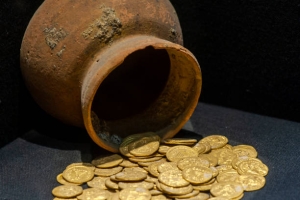
There were two types of money in the fifteenth century, money of account and actual coinage
Money of Account
The English pound [£] or livre was divided into 20s (shillings) the shilling into 12d (pence).
The English mark was worth 13s 4d – two thirds of a pound
In France the livres tournois was the standard money of account. Divided into 20 spouis and 12 Deniers. Nine livres tournois equalled one English pound.
Coinage
There were no pound, mark, or shilling coins.
The English noble was a gold coin worth 6s 8d, half a mark.
The English silver penny was also a money of account and worth 1/240th of one pound sterling.
Silver minted coins: Groat = 4 pence; half groat; penny; halfpenny; farthing
In France the franc was a silver coin worth one livre.
The ecu was a gold coin worth 3s 4d sterling.
The salut was a gold coin minted in in Lancastrian France worth one and one half livres or 30 shillings. The French also minted the salut.
Incomes
A rough estimate of incomes: a parish priest received between £5 and £10 a year depending on the wealth of his parish., An archer might expect to earn £9 a year. The average income of a knight was £60. A lord’s income from land and crown annuities amounted on average to £865 from which he would pay his retinue and domestic servants. Richard, Duke of York the richest magnate in England claimed to be worth £3,230 a year.
Taken from J. Sumption, The Hundred Years War vol V, Triumph and Illusion, pp. 822-823
******************************
֍ Key Events
King Henry VI, Birth and Baptism
The Death of King Henry V
The Minority Council
The Dual Monarchy
*****************************
King Henry VI, birth, baptism, accession
King Henry VI was born at Windsor on 6 December 1421.
He became King of England on 1 September 1422 when he was nine months old.
The last four months of 1422 were the first four months of King Henry VI’s reign.
King Henry VI was the only child of King Henry V and Catherine of Valois the daughter of King Charles VI of France. He was born at Windsor on 6 December, Saint Nicholas Day, and named for his father.
“In þat tyme vppone saynt Nicholas evyn, come tythynges from Wyndyssore to þe Maire, þat oure Quene Dame Kateryne, had borne a prince, a fayre sone. And a-none all þe belles in London were re[n]gon; ‘Te Deum’ was songone at Paules; And þer was the Chauncelere and many bysshoppys, And þe Maire and hys Aldermen, And all þe craftes of the Cite.” Brut Continuation E, p. 448
Henry was baptised by Henry Chichele, Archbishop of Canterbury. His godparents were his uncle John, Duke of Bedford, his great uncle Henry Beaufort, Bishop of Winchester, and a high-ranking visitor to England, Jacqueline, Countess of Hainault (1, 2).
“And sone aftur, Kynge Henry the vi was born in the castell of Wyndesore, the day of seynt Nicholas the Bisshop the yere of oure Lord Ihesu Criste M cccc xxj, whos godfaderis and godmoderis at the fontstone weren these: sir Henry Beauford, Bisshop of Wynchestir, and John, Duke of Bedford; and the Duchesse of Holand was his godmodir; and at his confirmaciion the Erchebisshop of Caunterbury was his god ffadir.” Brut Continuation D, p. 427
“Also in the forseid monthe of Decembre on seynt Nicholl day, the yere of oure lord a m1 ccccxxj, Herry the kynges sone was born at Wyndysore, whos goodfadres at the font were Herry bysshop of Wynchestre, sithe Cardynall, and John, duke of Bedford, and Jacomyn duchesse of Holand was hys goodmodyr; and his goodfadir at his confirmacion was Henry Chicheley erchebysshop of Caunterbury.” A Chronicle of London (Harley 565), p. 110.
“This same yere vpon seint Nicholas day in decembre was henry, the kyng’s ffirst begotyn son, born at Wyndsore, whos godfaderes beth att the font stand herry bysshop of Wynchester, and John duke of Bedford. And the duches of holand whas godmoder. And att the confirmacion the Erchebysshop of Caunterbury, henry Chichele, whas godfader.” Chronicles of London (Cleopatra C IV) p. 128 and (Julius B II) p. 74
Henry became king on 1 September 1422 when he was less than a year old. His regnal years date from 1 September to 31 August.
Henry would not remember a time when he had not been king. The situation was unprecedented. No king of England had succeeded to the throne at so young an age. Henry III was nine when his father died in 1216, and Richard II was ten when his grandfather, Edward III, died in 1377. Henry VI was the only English king to be crowned twice and buried twice. Uniquely at a time when military prowess was required of a king, Henry never took part in a battle, although England was at war, first with France and then with herself, throughout his reign.
Henry VI’s Guardians
John, Duke of Bedford.
Humphrey, Duke of Gloucester.
Thomas Beaufort, Duke of Exeter.
Sir Walter Hungerford.
William, Lord Fitzhugh.
As he lay dying Henry V named his brothers, John, Duke of Bedford as Regent of France and Humphrey, Duke of Gloucester as guardian and defender (tutelam et defensionem principales) of Henry VI, but he entrusted the personal care and education of his infant son to his uncle Thomas Beaufort, Duke of Exeter, in association with Sir Walter Hungerford, steward of the royal household and Henry, Lord Fitzhugh, chamberlain of the royal household, one of whom was to stay with Henry VI at all times (1).
Several chronicles record that Henry Beaufort, Bishop of Winchester was named as a guardian. The chroniclers were misled because Beaufort was Henry VI’s godfather and he played a leading role in government during Henry VI’s minority. The error was repeated by the Tudor chronicler John Stow (2). Richard Beauchamp, Earl of Warwick is also mistakenly named, but he did not become Henry’s guardian until 1428.
“Kynge H. beinge sicke made his testament, apoynted his treasure and jewells to be solde, his dettes to be payde, as well to the pleasaunce of his souldiours as to othar that he owght good vnto in Englond, and in Fraunce, and ordeyned John, his brother, duke of Bedforde to be theyr regent and governor of Fraunce and Normandy; and he comitted the kepinge of H. his yonge sonne and prynce to sir Henry Beaufort, byshope of Winchester, and to sir Thomas Beaufort, duke of Excestar.” English Historical Literature, London Chronicle for 1421 to 1430
“And for his tendir and yonge age, Henry his ffadir comyttid hym to the kepynge of Sir Henry Beauford, Bisshop of Wynchestre, and to Sir Thomas Beauford, Duke of Exetre bothe his bele vnclys; and the kepynge of Fraunce and Normandie to Iohn the Duke of Bedford, to ben regent and gouernoure of bothe there, tille that Henry, his yonge sone, by his good counseile wold set it in bettur gouernaunce. And the kepinge of Engelond to sir Vmfray, the Duke of Gloucestre, to ben Proptectour and deffendour of the Rewme tille that Henry his yonge sone, by alle the good counseile of Engelond, wold set and put it into bettur gouervaunce, and to moste profite of the Kynge and of the Rewme.” Brut Continuation D, pp. 429-430, repeated p. 431
On orders from his father the young king was placed under the protection of Henry, Bishop of Winchester and Richard Earl of Warwick. Giles, Chronicon, p. 3
And to Richard, Erle of Warrewik, was commyttit þe kepyng of hym, for-as-much he was countet and hold þe best-nurturet man of Englond. Brut Continuation H, p. 564
*************************************************************
(1) P. & F. Strong, ‘The last will and codicils of Henry V,’ English Historical Review XCVI (1981).
(2) Stow, Annales, p. 361.
***********************************************
King Henry V
King Henry V invaded France in 1415.
He conquered the Duchy of Normandy in 1419
He claimed the crown of France in 1420.
King Henry V invaded France and won his great victory at the Battle of Agincourt in 1415. Over the next four years he conquered the Duchy of Normandy, claiming it as his inheritance by direct descent from William the Conqueror, Duke of Normandy.
Henry continued his conquest of northern France and in 1420 by the Treaty of Troyes, King Charles VI and Queen Isabelle faced with almost certain defeat, disinherited their heir, the Dauphin Charles, They ‘adopted’ Henry V as their son and heir and agreed to his marriage with their daughter Catherine. Henry became Regent of France for his father-in-law. He would become King of France on Charles VI’s death. He undertook to continue the war until he had conquered all the provinces still owing obedience to the Dauphin (1).
(1) Sumption, Cursed Kings, Chapter 18, ‘The Death of Princes,’ pp. 735–771.
The Kingdom of France
King Charles VI of France suffered from periodic bouts of insanity.
France was divided by the civil wars.
The Kingdom of France was riven by civil war in a power struggle over who should govern the country in the name of the hapless King Charles VI. Charles’s periodic bouts of insanity or ‘absences’ as they were called made him unfit to rule, often for long periods. John, Duke of Burgundy, the most powerful man in France, known as ‘the Fearless’ was determined to ‘rule’ France for his own profit.
King Charles’s only surviving son the Dauphin Charles was fifteen when he was driven out of Paris and out of government in 1418 by John the Fearless.
The Dauphin declared himself Regent of France. He and his advisors set up a rival government centred on the town of Bourges in the Loire valley (1). The English would refer to him as the ‘Dauphin’ or ‘the little King of Bourges’ for many years after his father’s death and his own coronation. The Dauphin’s supporters became known known as the Armagnacs, in opposition to John the Fearless and his ‘Burgundians.’ The civil war materially aided Henry V’s conquests in northern France.
An attempted reconciliation between John the Fearless and the Dauphin in 1419 ended in disaster. Duke John was assassinated in the Dauphin’s presence and John’s son Philip, now Duke of Burgundy vowed never to forgive his father’s murder. He allied with Henry V and recognised Henry’s claim to the throne of France.
(1) Beaucourt, Charles VII vol I, p. 120 and pp. 473–474. (Dauphin as Regent of France).
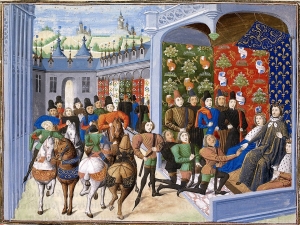
The Treaty of Troyes
The Treaty of Troyes disinherited the Dauphin Charles, heir to the French throne.
King Henry V became Regent of France.
The Treaty of Troyes was negotiated by King Henry V and Philip, Duke of Burgundy in 1420. It was a symbiotic pact born of self-interest on both sides. Henry V needed yjr Duke of Burgundy, the most powerful prince in France, as an ally if he was to fulfil his dream of conquering France. Burgundy allied with Henry V because he had vowed to revenge his father’s murder.
The Treaty of Troyes was endorsed by the helpless King Charles VI and Queen Isabelle. They disinherited the Dauphin, their only remaining son, and made King Henry V of England Regent of France to become king when the aging and mentally unstable King Charles should die. Henry made doubly sure of the inheritance by marrying their daughter, the Princess Catherine.
It was hoped and believed by some royal officials that the treaty would bring peace. It was accepted by an assembly of French nobles loyal to King Charles VI. Henry V’s conquest of the Duchy of Normandy and other parts of northern France gave them no choice.
The Estates General representing northern France ratified the treaty, but it was repudiated by the rest of the country which remained loyal to the Dauphin. Henry V undertook to obtain the submission of all those opposed to him by military conquest, so the prospect of peace was largely an illusion. Henry V died unexpectedly at Vincennes the end of August 1422 before he had time to complete his conquest.
Henry V’s Death and Burial
King Henry V died on 31 August 1422.
His body was brought back to England for burial.
Henry V died at Bois de Vincennes near Paris on 31 August 1422 at the age of thirty-six after a spectacular reign of nine and a half years, the first king of England to die abroad since Richard I in 1199.
“Memorandum stating that King Henry V died at the castle of Bois de Vincennes, near Paris, on the last day of August 1422 in the tenth year of his reign and was succeeded by his son King Henry VI on the first day of September, in the first year of age and of his reign” (1).
Queen Catherine was in Paris when Henry V died. She and her entourage escorted Henry’s body home. His funeral cortege took two months to reach England passing through Paris to Rouen and on to Calais, crossing to Dover and proceeding Westminster in slow stages. At each place his coffin rested the clergy sang the mass and performed funereal services for the dead king (2, 3).
The Mayor of London, William Waldern and the aldermen all dressed in black, received Henry’s coffin into the City at Blackheath on 6 November. The annual processions through the City to Westminster for the installation of the sheriffs at the end of September, and of the mayor at the end of October, were cancelled because the City was in mourning; breaking with tradition they travelled quietly to Westminster by barge (4).
“And in ϸat yere ϸe Shryves of London went by barche to Westmynstre, And dyvers craftes of London with ϸaim; And in ϸis year ϸai come home agayne, all in blak. And ϸis was done because of our Kynges deth: on whos soule God haue mercy! Amen!
In þat yere þe Maire and þe Aldermen and all þe craftes went to Westmynstre by barge, all in blak, þe v. day of Nouember ; And þer he toke hys oth in þe eschekere, as þe maner is. And whene he had done, he toke hys barge with all þe craftis, And come home agayne.” Brut Continuation E, p. 449
Henry V was buried in Westminster Abbey on 7 November. The funerary arrangements were extensive, elaborate, and expensive, as befitted England’s warrior king. Robert Rolleston, Keeper of the King’s Great Wardrobe, supplied ‘cloths of gold’ and other items from the Great Wardrobe, valued at £83 7s 6d, to be offered at Westminster Abbey (5, 6).
*********************************************************
(1) PPC III, p. 3 (Henry V’s death).
(2) Foedera X, pp. 255–257 (for ships, carriages, hearses, and funerary equipment).
(3) PPC III, p. 5 (lodging for those escorting and meeting the cortege).
(4) Sharpe, London, Letter Book K, pp. 2–3, (Henry’s reception).
(5) L&P I, p. 385 and 388 (cloths of gold).
(6) Lisa Monnas,‘Textiles from the Funerary Achievements of Henry V,’ in J. Stratford, Lancastrian Court, pp. 125–146.
***************************************************
The Great Seal
The surrender of the Great Seal of England by the Chancellor.
 On the death of a monarch the king’s Great Seal of gold, held by the Chancellor, had to be surrendered to the new king. The lords who were not in France came in all haste to Windsor to carry out the customary procedure, handicapped by the age of the baby king.
On 28 September 1422 in the ‘presence’ of King Henry VI, the Chancellor Thomas Langley, who had rushed south from his bishopric of Durham, put the Great Seal into the hands of Humphrey, Duke of Gloucester and Gloucester entrusted it to Simon Gaunstede Keeper of the Chancery Rolls, who traditionally took charge of it when the chancellor was out of England. Gaunstede retained possession of the Great Seal until it was returned to the Duke of Gloucester in November while Parliament was in session (3).
See Humphrey, Duke of Gloucester below.
The transfer was witnessed by Henry Chichele Archbishop of Canterbury, Henry Beaufort, Bishop of Winchester, Philip Morgan Bishop of Worcester, a former Chancellor of Normandy, Edmund Lacy Bishop of Exeter, and Richard Fleming Bishop of Lincoln. James Butler Earl of Ormond, the king’s lieutenant in Ireland, John, Lord Talbot, John Stafford, Keeper of the Privy Seal, William, Lord Clinton and Robert, Lord Poynings, who were presumably near at hand (1, 2).
*********************************************
(1) PPC VI, pp. 343–344 (surrender of the Great Seal).
(2) Foedera X, p. 253 (surrender of the Great Seal).
(3) Foedera X, p. 262. (Gaunstede was paid for keeping the seal from 28 September to 17 November 1422).
********************************************
The Temporary Council
A temporary council assembled in September 1422.
A temporary council of the lords assembled in the Star Chamber at Westminster on the following day, 29 September, and handled the unexpected transition of government smoothly and competently. On their authority, the king’s officers and the judiciary were reappointed to ensure continuity of administration. Writs to summon Parliament were also issued on 29 September (1).
(1) Report on the Dignity of a Peer IV, pp. 855–857 (summons to Parliament).
The primary concern of the Temporary Council was to ensure the smooth transition of power and the maintenance of law and order in the wake of Henry V’s death. Wales was always turbulent, and one of the Council’s first acts was to proclaim the king’s peace along the Marches of Wales.
On 1 October the sheriffs of Worcester, Gloucester, Hereford, Staffordshire, and Shropshire, were ordered to make public proclamations of the king’s peace. Two days later John, Lord Talbot and his brother William Talbot, who held lands in Hereford and Shropshire, and Sir Edmund Ferrers of Chartley, whose lands were in Staffordshire, received instructions to suppress lawlessness along the Welsh border (1).
Henry V’s appointees, William Troutbeck the Chamberlain of Chester, William Botiller the Chamberlain of South Wales, and Thomas Walton the Chamberlain of North Wales were confirmed in their offices (2, 3).
**************************************
(1) Foedera X, p. 254 (Talbot and Ferrers).
(2) CPR 1422-29, pp. 3–4 and p. 60 (appointments in Wales).
(3) Griffiths, ‘William Botiller: A Fifteenth Century Civil Servant,’ in King and Country, pp. 179–186.
*******************************************
The Minority Council
The Lords in Parliament created the Minority Council to govern England until King Henry came of age.
Humphrey, Duke of Gloucester, Protector of England.
The Officers of State.
The Bishops.
The Magnates.
Lords and Knights.
By the time the first Parliament of Henry VI’s reign met on 9 November 1422, the temporary council had decided on conciliar government. They were determined that until Henry VI came of age England would be ruled by a Council acting in his name and on his authority and not solely by a Regent (1). They settled the Minority Council among themselves. It was made up of men who had served Henry V (2, 3).
A memorandum of the Parliament of 1422 dated in the Proceedings, Chronological Abstracts, to 9 November1422, the day Parliament assembled, is a recapitulation, partly in Latin and partly in English of what had been accomplished in that Parliament (4).
“In whiche parlement was ordeyned the governaunce of the kyng, how and in what manere he schude be governed in his tender age.” Great Chronicle, p. 123; A Chronicle of London (Harley 565), p. 110; Gregory’s Chronicle, p 149.
The chroniclers’ statement is misleading. The question of who would rule England was settled by the authority of Parliament but the Lords, not the Commons, made this decision. As Professor Griffiths puts it: ‘such matters were considered inappropriate for discussion by the Commons, who simply received the lords’ decision’ (5).
Henry V’s two surviving brothers, John Duke of Bedford and Humphrey Duke of Gloucester became Regent of France and Protector of England respectively.
See John Duke of Bedford and Humphrey, Duke of Gloucester below.
**************************************************
(1) Watts, Henry VI and the Politics of Kingship, pp. 113-114 (comciliar government).
(2) Harriss, Beaufort, pp. 118–119. (Minority Council)
(3) PROME X, p. 26 (Minority Councillors).
(4) PPC III, pp. 13-18 (Parliament).
(5) Griffiths, Henry VI, p. 24 (decision by the Lords).
*************************************************
The Three Great Officers of State
The Duke of Gloucester informed the Commons at their request of the names of the three Great Officers of State. The Commons ratified the decision on 16 November (1).
Thomas Langley, Bishop of Durham, Chancellor. He became Bishop of Durham in 1406 under Henry IV. He was Chancellor under Henry IV, Henry V and Henry VI. He resigned as chancellor 1424 but remained a part time councillor until his death in 1437 (2).
William Kinwolmersh. Treasurer. He died in December 1422 and was replaced by John Stafford, Keeper of the Privy Seal.
William Alnwick replaced Stafford as Keeper of the Privy. He became Bishop of Norwich 1426.
**********************************************
(1) PROME X, pp. 16-18 (Officers of State).
(2) Foedera X, p. 259 (Langley’s appointment as Chancellor).
*************************************************
The Bishops
 Henry Chichele. Archbishop of Canterbury from 1414. Present at the surrender of the Great Seal.
Henry Beaufort, Bishop of Winchester. Great uncle of Henry VI. Beaufort was the richest man in England. He was the most influential member of the Minority Council except for the Duke of Gloucester. He became Chancellor in 1424.
Philip Morgan, Bishop of Worcester. First Chancellor of Normandy in 1418.
John Wakering. Bishop of Norwich. Keeper of the Privy Seal under Henry V. He was in Normandy when Henry V died.
John Kemp, Bishop of London.
As Chancellor of Normandy Kemp held two seals, one for Normandy, and another, similar to the Great Seal of England, that Henry V had with him in France. Kemp surrendered the seal for Normandy to the Duke of Bedford in Rouen before he returned to England. He brought the second seal with him and surrendered it to the baby king at Windsor in the presence of the Duke of Exeter and the Earls of Warwick and March, all of whom had returned from France (1).
(1) PROME X, p. 15 (Kemp returned the king’s seals).
The Magnates
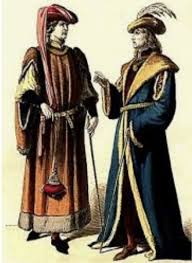 Humphrey, Duke of Gloucester, Protector.
Thomas, Beaufort, Duke of Exeter, the young king’s guardian. Younger brother of Henry Beaufort and great uncle of Henry VI.
John Mowbray, Earl of Norfolk, Earl Marshal of England.
Edmund Mortimer, Earl of March. Named as the king’s lieutenant in Ireland in 1423. He crossed to Ireland in 1424.
Richard Beauchamp, Earl of Warwick. He became Henry VI’s guardian in 1428.
Wardens of ther March
Henry Percy, Earl of Northumberland. Warden of the East March towards Scotland.
‘It was agreed in full parliament’ on 12 December that 1,000 marks should be paid to the Earl of Northumberland as Warden of the East March and custodian of Berwick.
Ralph Neville, Earl of Westmorland. Warden of the West March with his son Sir Richard Neville.
Sir Richard Neville, would receive 500 marks as Captain of Carlisle and Warden of the West March (1).
See Year 1423: The Wardens of the March.
(1) PPC III, pp. 7-8 (Wardens of the March).
The Lords and Knights
Sir Walter Hungerford. Steward of the household. Executor of Henry V’s will.
Henry, Lord Fitzhugh. Chamberlain of the household. Executor of Henry V’s will.
Ralph, Lord Cromwell. Not a member of Henry V’s household.
John, Lord Tiptoft, household official.
Sir Walter Beauchamp, household official.
Parliament
The first Parliament of Henry VI’s reign met on 9 November 1422. It was dissolved on 22 December.
A summary of the acts of parliament in the Proceedings for 1422 is misdated by the editor to 9 November the day Parliament assembled.
It is a recapitulation, partly in Latin and partly in English, of the acts of Parliament to 18 December, drawn up on 18 December, the day Parliament was dissolved (1).
(1) PPC III, pp. 13-18 (summary).
Grants
Queen Katherine’s dower.
The Earl of Stafford, livery of his lands.
Thomas Payne.
Alexander Home.
King Henry V had endowed Queen Catherine with lands in England and in Normandy. Parliament confirmed Catherine’s dower in England and added Leeds Castle in Kent, the castle and town of Rochester, and the castle and town of Hawardin to her estates (1).
Humphrey, Earl of Stafford was granted livery of his father’s lands in accordance with a promise made to him by Henry V just before he died, even though Humphrey would not come of age for another year (2, 3).
**************************************************
(1) PROME X, pp. 43–55 (list of Catherine’s dower lands).
(2) PROME X, Item 18 Appendix, pp. 62–63 (Livery of lands to Stafford).
(3) Foedera X, 259 (Grant to Catherine and livery of his lands to Stafford).
*********************************************************
Thomas Payne
A native of Wales, Payne was imprisoned in Newgate on suspicion of treason. He had been Sir John Oldcastle’s lieutenant during the Lollard uprising of 1414 against Henry V (1). William Hankford, Chief Justice in King’s Bench, had been instructed to order the sheriffs of London to keep Payne in safe custody or risk severe penalties if they allowed him to escape (2).
Thomas Payne petitioned Parliament to have his case heard speedily as he had been in prison for a long time (3).
According to testimony given to King Henry and the Council many years later in 1438 by one Thomas Haseley, a chancery clerk, who was seeking an annuity, he had captured Payne in 1422 before Henry V died, and the Duke of Bedford had committed Payne to the Tower of London (5). Payne escaped but was recaptured and returned to the Tower. He was then moved to Newgate prison (6).
See Year 1438: Thomas Haseley.
**********************************************************
(1) Wylie & Waugh, Henry V, vol III, p. 395, n. 1.
(2) PPC III, p. 3 (order to sheriffs).
(3) Rotuli Parliamentorum IV, p. 196 (Payne’s petition in full).
(4) PROME X, Appendix Item 20, p. 63 (Payne’s petition noted).
(5) PPC V, pp. 104–107 (Haseley’s testimony).
(6) Issues of the Exchequer, pp. 373 and 375 (Payne recaptured).
************************************************************
Alexander Home
Alexander Home (Hume) had been imprisoned in the Tower with four other Scots in May 1421 on Henry V’s orders (1, 2). He was the son of Sir Alexander Home of Dunglass who had been captured at the Battle of Homildon Hill in 1403 fighting against King Henry IV. The reason for their imprisonment is not stated.
Henry Percy, Earl of Northumberland, Warden of the East March, posted a bond for £500 in December 1422 for Alexander’s release. He undertook to surrender Alexander to the Council before Easter 1423 if the bond was not honoured (3, 4). Did Northumberland plan to use the young Alexander as a bargaining counter in negotiations with the Scots?
******************************************************
(1) CFR 1413-1422, p. 22 (imprisonment).
(2) Calendar of Documents Relating to Scotland IV, p. 183 (imprisonment).
(3) PPC III, p. 12, n.1 (Northumberland’s bond).
(4) CClR 1422-1429, p. 53 (Northumberland’s recognizance).
*****************************************************
Taxation
The Commons granted the traditional subsidy (tax) on wool.
The Commons were not overly generous in 1422. They renewed the traditional grant of the subsidy (tax) on wool, which had lapsed automatically on Henry V’s death, and backed dated it to 1 September 1422, the first day of Henry VI’s reign (1).
Customs duties on wool was the crown’s principal source of income, used partly to pay off outstanding debts but mainly as security to raise loans. The Commons granted a tax of five nobles [33s 4d or £1 13s 4d] on every sack of export wool and every 240 wool fells (tanned skins) shipped by English merchants for the next two years.
Foreign merchants (aliens) were to pay [53s 4d (£2 13s 4d] on every sack of wool; tonnage (duty on imported wines) was set at 3 shilling per tun; and poundage (duty on imports) at 12 pence in the pound, for the next two years (1).
Gregory’s Chronicle says, ‘during the term of the yere.’ The Great Chronicle says three years.
“Also in that Parlyment was grauntyd unto the kyng v. noblys of every sacke wolle duryng the terme of the [so in MS.] yere.” Gregory’s Chronicle, p 149
“Also it was graunted to the kyng v nobles of every sak wolle to custome during iij yere.” Great Chronicle, p. 123
(1) PROME X, pp. 21–22 (tax grant).
Humphrey, Duke of Gloucester
The Duke of Gloucester became Protector of England.
The Duke of Gloucester, King Henry’s youngest brother also expected to become Regent of England. The lords thought differently.
Twenty-one lords were present at a council meeting on 5 November 1422, including those who had been in France with Henry V died. They had returned to London and added their weight to the temporary council.
As a first step towards limiting his ambition, the Council nominated Gloucester to open Parliament in the king’s name in the absence of the Duke of Bedford, but only with the assent of the Council.
Gloucester protested vigorously that this phrase curtailed his rightful powers. He argued that he had opened and closed Parliament as Custodian of the Realm while Henry V was in France and that to deny him this right would undermine his status. The lords replied that the circumstances were entirely different, Henry V had given him the authority, but Henry VI could not, and that authority now rested with the Council (1).
Stung by the lords’ decision, Gloucester prepared a memorandum in which he vehemently defended his right to become Regent or Governor of England, to rule with the advice but not with the consent of the lords (2, 3, 4). According to Gloucester the lords had initially assented to Henry V’s codicil making him tutela et defensionem principales but they then reneged on their promise to assist him.
Gloucester drew their attention to the title bestowed on William Marshal during the minority of King Henry III as ‘Ruler of the King and of the Kingdom’ Rector regis et regni Angliae. He requested to be named Ruler or Governor of the Kingdom but said he would not go so far as to claim to be ruler of the King (the sole legal source of authority). If the style and status of Governor of the Kingdom was accorded to him, he would govern with the advice of the Council, but if they were split, his decision should prevail.
Gloucester claimed that the Commons had asked the Lords to name a governor (although this request is not on the Parliament Roll) but that the title proposed for him of Defender and Chief Councillor was insufficient, it did not meet the Commons’ expectations. He made the point that his claim was for himself alone and should not prejudice his brother’s rights.
Perhaps to postpone a final decision and give himself time to get Bedford on side, Gloucester suggested hopefully that the Lords should wait until Bedford returned to England to settle the question. Both brothers would then accept whatever was decided. The Lords would have none of it.
On 5 December 1422 the Lords in Parliament named the Duke of Bedford as Protector and Defender of the realm, and principal councillor of the King whenever he was in England. The Duke of Gloucester would be Bedford’s deputy as Protector during his absence. Bedford commanded far more respect than Gloucester. Had he been in England the outcome might have been different, but as it was neither Bedford nor Gloucester was recognised as Regent of England (5, 6, 7, 8).
******************************************************
(1) PPC III, pp. 6–7 (council meeting in November).
(2) English Historical Documents, ed. Myers, pp. 232–33.
(3) PROME X, Appendix p. 61. Printed in modern English.
(4) Chrimes, ‘The Pretentions of the duke of Gloucester in 1422,’ English Historical Review XLV (1930). Reprinted in Chrimes & Brown, Select Documents, pp. 248–249.
(5) PROME X, pp. 23–24 (Concerning the appointment of the protector and defender of the realm of England).
(6) Foedera X, p. 261 (appointment of Bedford).
(7) CPR 1422-29, p. 65 (appointment of Bedford).
(8) Roskell, ‘The Office and Dignity of Protector of England with special reference to its origins,’ in Parliament and Politics I, pp. 193–234.
***********************************************************************************
Gloucester as Protector
In December the Council awarded him £300 as Protector (1).
To enhance his dignity and perhaps to soothe his pride, Parliament created Gloucester Great Chamberlain of England and granted him the constableship of Gloucester castle, with all its profits (2). Gloucester chose to use his title Great Chamberlain of England over that of Protector and Defender.
Peter de Alcobasse a Portuguese physician naturalised in 1420, one of the king’s physicians, petitioned Gloucester for a prebend in St George’s Chapel Windsor (3). The grant is headed Le Roy la Grante and signed H. Chambellan d’Angleterre. (4, 5).
Henry V gave Gloucester two purses of gold garnished with jewels each worth £2,000 as surety for payment for the men-at-arms and archers he had contributed to Henry’s campaigns (6). Henry had ordered Gloucester to return them to the Exchequer; he wanted the purses as gifts for the Dukes of Burgundy and Bavaria (possibly to pay them for the troops they supplied). The Council authorised the Exchequer to reimburse Gloucester for their value. Gloucester was parsimonious, he never missed an opportunity to enrich himself with lands or money at the crown’s expense.
****************************************************
(1) PPC III, p. 11 (£300 wages).
(2) PROME X, pp. 22–23 (Great Chamberlain).
(2) PPC III, p. 11 (£300 wages).
(3) Talbot and Hammond, Medical Practitioners, pp. 246–47 (Alcobasse).
(4) Foedera X, p. 263 (petition for prebend).
(5) CPR 1422-29, p. 13 (petition for prebend).
(6) PPC III, pp. 8-10 (gold purses).
***************************************************
John Duke of Bedford, Regent of France
The Duke of Bedford became Regent of France
John, Duke of Bedford was thirty-three when Henry V died and he became Regent of France. He was a brilliant administrator and an able soldier, but he was relatively unknown in France, and he faced a monumental task. He had to defend Henry V’s conquests and attempt to extend them but without the X-factor, Henry V’s charisma and reputation for invincibility (1).
Bedford responsibilities made it impossible for him to return to England and attend Parliament in 1422. Nevertheless, as heir presumptive to the throne he expected to become Regent of England. He wrote from Rouen to the Mayor and Common Council of London on 26 October (and probably to the Council although his letter has not survived).
“the gouvernance of the Reaume of England after [by] the lawes and ancient usage and custume of the same Reaume as we be enformed belongeth un to us as to ϸe elder brother of our saide souverain lord that was. And as next unto ϸe croune of England and having the chief interesse after the king [that now is] . . . .” (1)
Bedford may have envisaged an arrangement similar to that made by Henry V, with the Duke of Gloucester as Custodian of the Realm in his absence.
******************************************
(1) Sharpe, London and the Kingdom III, pp. 367–68.
Reprinted in Chrimes & Brown, Select Documents, p. 245.
******************************************
Death of King Charles VI of France
King Charles VI of France died on 21/22 October.
 King Charles VI died at his residence, the Hotel St. Pol in Paris on 21/22 October 1422 after an unspectacular reign of forty-four years. It was a sad ending to a sad life.
“This same yere vpon a wednesday the xxj day of October, the owre betwene vj and vij in the mornyng, dyed kyng Charles of ffraunce in his hous of seint poule with in the cite of Parys, and ys buryed at seynt Denys.” Chronicles of London (Cleopatra C IV) p. 128
Chronicles: Chronicle of London (Harley 565), p. 179; Chronicles of London (J.B. II) p. 74; Great Chronicle, p. 123; Gregory’s Chronicle p. 149; Brut Continuation D, p. 440 (misdated to 1420-21); Brut Continuation G, p. 497; Brut Continuation H, p. 563 (confuses Charles VI’s place of death with that of Henry V).
French officials wished to establish a Council of Regency to rule France comprised of judges, royal officers. and princes of the blood. The Duke of Bedford would have none of it. HE was Regent of France. He came from Rouen to arrange and preside over the royal funeral as chief mourner. No French magnate was present. The Bourgeois of Paris noted that ‘not one [member] of the house of France was there that day . . . . nor any lord at all except one English duke, called the Duke of Bedford.’ (1)
On 9 November, two days after King Henry was buried in Westminster, and three weeks after he died, King Charles’s coffin, escorted by the clergy, by representatives of the university of Paris, and by the city’s civic dignitaries was carried in procession to Notre Dame and then to St Denis for burial.
After the ceremony Bedford left the church with the sword of state of the French kings carried upright before him. This caused great offence to the citizens of Paris. Bedford might be Regent, but he was not king of France (2).
Bedford summoned the parlement of Paris in November 1422 and required its members to swear an oath to keep the peace and to acknowledge Henry VI as King of France. He reminded the assembly that the Dauphin Charles had no right to the throne: he had been disinherited because he was responsible for the murder of John the Fearless, Duke of Burgundy. Bedford swore the traditional oath to rule justly and peacefully, and he received the oaths of loyalty from the judges and officers (3).
*********************************************
(1) Bourgeois of Paris, pp. 179–183.
(2) Monstrelet, Chronicles I, trans. Johnes, pp. 486–487.
(3) L&P I, pp. lxxvii–lxxx. (parlement of Paris).
*******************************************
The Dual Monarchy
Henry VI became King of France on the death of King Charles VI.
One king, two kingdoms.
King Henry VI of England was now King Henri II of France. The Treaty of Troyes had united the crowns of England and France, creating the dual monarchy, one king, but two kingdoms. It was Henry V’s legacy to the son he had never seen. The concept would prove impossible to maintain after Henry V’s death. He might have managed it, but no one else could.
Henry V’s second legacy to his son was the crippling cost of the war in France to establish the dual monarchy. Henry V was massively in debt when he died, and Henry VI inherited a burden he would never be free of.
The crown’s income, from Parliamentary taxation, customs duties, and the royal demesne, including the Duchy of Lancaster, came nowhere near meeting the expenditure on a war not just of conquest but also of occupation.
The Duke of Bedford summoned the parlement of Paris in November 1422 and required its members to swear an oath to keep the peace and to acknowledge Henry VI as King of France. He reminded the assembly that the Dauphin Charles had no right to the throne: he had been disinherited because he was responsible for the murder of John the Fearless, Duke of Burgundy (1).
Bedford decreed that anyone who opposed the dual monarchy and supported the Dauphin Charles was to be referred to as an ‘Armagnac’ and not as French. Good Frenchmen were now Henry VI’s subjects. The term ‘Armagnacs’ is used frequently in the English chronicles to denote the enemy (2).
*************************************************
(1) L&P I, pp. lxxvii–lxxx. (parlement of Paris).
(2) BL. Birch MS 4101 ff 65–69 printed in B. J. H. Rowe, ‘Discipline in Norman Garrisons,’ English Historical Review XLVIX, (1931), pp. 201–06; p. 205 for the Armagnacs.
****************************************************
The Anglo-Burgundian Alliance
The Duke of Burgundy allied with England to form the Anglo-Burgindian alliance against France.
Philip, Duke of Burgundy was the most powerful man in France after Henry V died. He had allied with Henry V in an emotional moment in 1419 to punish the Dauphin Charles for the murder of his father, John the Fearless Duke of Burgundy.
The Treaty of Troyes, making Henry heir to the throne of France sealed the Anglo-Burgundian alliance. On his deathbed Henry ordered the Duke of Bedford to preserve the alliance with Burgundy (1).
In his will King Henry entrusted the safe keeping of the Duchy of Normandy to Bedford. Bedford met Philip in Paris to discuss the Regency. The Burgundian chroniclers Enguerrand de Monstrelet and Georges Chastellain claim that King Henry instructed Bedford to offer the Regency of France to Burgundy but that Burgundy refused it (2).
“By the authority of the kings of France and of England and their grand council, the Duke of Bedford was appointed Regent of France in consequence of the Duke of Burgundy not wishing to undertake that office” (3).
The only English source to confirm this is Walsingham’s Historica Anglicana. But as Griffiths points out, Walsingham’s chronicle ends on 31 August 1422. “Walsingham could not record Bedford’s eventual nomination as regent because his chronicle had already ended” (4, 5).
It is doubtful that Bedford offered the Regency to Burgundy, although the possibility may have been discussed. Bedford was responsible for protecting the inheritance of his baby nephew; he was also heir presumptive the throne of England. At the same time, he had to maintain cordial relations with Burgundy; his future policy and strategy depended on the Anglo Burgundian alliance.
In any case, Duke Philip did not want the regency. Unlike his father, he had no ambition to ‘rule’ France, his interest lay further east, in an expansion of Burgundian domination over the Netherlands (6). And while an alliance with England was useful to him, Duke Philp was still politically and emotionally first and foremost, a prince of France. He would not serve as Regent, or rule France in the name of the King of England. He carefully avoided any occasion that would require him to swear fealty to Henry VI, and he did not come to Paris when King Charles VI died in October 1422.
***********************************************
(1) Williams, My Lord of Bedford (Henry’s instructions to Bedford).
(2) Monstrelet, I, trans. Johnes, p. 486.
(3) Chastellain, Oeuvres, I, pp. 328–331 (Burgundy declined the Regency).
(4) Walsingham, Historica Anglicana II, p. 345.
(5) Griffiths, The Reign of King Henry VI, p. 19
(6) Vaughan, Philip the Good, p. 16 (Burgundy’s ambitions).
*******************************************************
Bibliography 1422
Primary Sources
Bourgeois of Paris, A Parisian Journal, trans. J. Shirley (Oxford, 1968)
The Brut, or the Chronicles of England II, ed. F.W.D. Brie, (Early English Text Society, 1908)
CClR. Calendar of the Close Rolls 1422-1429
CFR. Calendar of the Fine Rolls 1422-1429
CPR. Calendar of the Patent Rolls 1422-1429
Calendar of the Letter-Books of the City of London: Letter Book K, ed. R. R. Sharpe, (1911)
Chastellain, G., Oeuvres ed., Kervyn de Lettenhove, 7 vols. (Brussels, 1863-66)
Chrimes, S.B. and Brown, A.L., Select Documents of English Constitutional History 1307-1485 (1961)
A Chronicle of London ed. N.H. Nicolas & E. Tyrell (1827)
Chronicles of London ed. C. L. Kingsford (1905)
Chronicon Angliae. Incerti Scriptoris Chronicon Angliae, ed. J.A. Giles (1848)
English Historical Literature ed. C. L. Kingsford, (1913)
Foedera, conventiones, literae…… 20 vols., ed. T. Rhymer, (1704-35)
Gregory’s Chronicle in The Historical Collections of a Citizen of London in the Fifteenth Century, ed. J. Gairdner, (Camden Society XVII, 1876)
The Great Chronicle of London, ed. A.H. Thomas, & I.D. Thornley, (1938)
Historia Anglicana, T. Walsingham, 2 vols ed. T.H. Riley (1836-1837)
Issues of the Exchequer ed. F. Devon (1837)
L&P. Letters and Papers Illustrative of the Wars of the English in France during the reign of Henry V, ed. J. Stevenson, Rolls Series, 2 vols in 3 (1861-1864)
Monstrelet, The Chronicles of Enguerrand de Monstrelet, trans. T. Johnes, 2 vols., (1877)
Myers, A. R., English Historical Documents, vol. IV, 1387-1485, (1969)
PROME. The Parliament Rolls of Medieval England, vols. X-XIII, ed. A. Curry & P. Horrox, (Boydell, 2005)
PPC. Proceedings and Ordinances of the Privy Council of England, 6 vols., ed. N.H. Nicolas, (Record Commission, (1834-37)
Secondary Sources
Barker, J. Agincourt (2006)
Barker, J., Conquest (2009)
Griffiths, R.A., The Reign of King Henry VI (1981)
Griffiths, R.A., King and Country: England and Wales in the fifteenth century, (1991)
Harriss, G.L., Cardinal Beaufort, (1988)
Roskell, J.S., Parliament and Politics in Late Medieval England, 3 vols, (1981-83)
Rowe, B. J. H, ‘The Grand Conseil under the Duke of Bedford 1422-35’ in Oxford Essays in Medieval History presented to H. E. Salter (1934)
Rowe, B. J. H., ‘Discipline in Norman Garrisons,’ English Historical Review XLVIX, (1931), pp. 201–06
Sharpe, R.R. (ed.) London and the Kingdom, 3 vols, (1895)
Strong, P. & F., ‘The last will and codicils of Henry V,’ English Historical Review XCVI, (1981)
Talbot. C.H., and Hammond, E.A., The Medical Practitioners in Medieval England (1965)
Vaughan, R., Philip the Good, (1970)
Watts, J., Henry VI and the Politics of Kingship (1996)
Williams, E. Carleton, My Lord of Bedford, (1963)
Wylie, J.H, & Waugh, W.T., The Reign of King Henry the Fifth, 3 vols (1914, 1919, 1929)